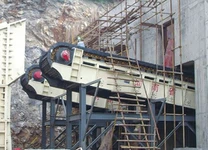
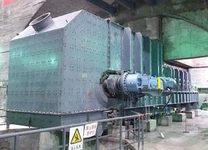
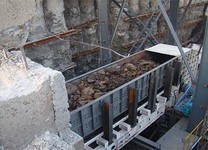
Heavy duty apron feeder is an important equipment in mining, metallurgy, port and chemical industries, but there is no precise design theory about the resistance caused by the hopper in the professional manual. The traction resistance formula is derived by using the latest bin pressure theory, and compared with the formula in many manuals, so as to point out the improper and missing of the original formula.
Heavy duty apron feeder plays an irreplaceable role in mining, metallurgy, chemical industry, port and other industries. Since the 1950s, the design and manufacturing level of domestic heavy duty apron feeder has made great progress, but there is still a certain gap compared with foreign countries (up to 12000t/h). An important reason is that the design theory of heavy plate is still limited to the most original simple calculation 1-magic. In particular, the friction between materials and materials, friction between materials and skirt plate and friction between materials and bottom plate and so on, there is no accurate design theory for decades, and large and large heavy plate above two kinds of resistance calculation is extremely important. Since the beginning of this century, some scholars have begun to study theoretically, but there are still many problems unsolved. The calculation formulas of shear resistance and friction resistance between material and skirt plate of straight skirt plate feeder are deduced systematically for the first time. Article [9] systematically derived various resistance calculation formulas of the feeder for the inclined skirt plate. 1 Resistance formula derivation to achieve similar function of vibration feeder and belt feeder, is not able to withstand warehouse pressure [cut. In the actual process layout of mining and other industries, the heavy plate is directly arranged under the silo, and there is no inclined heavy duty apron feeder "silo neck". Sometimes, the silo opening with a length of 20m is directly connected to the heavy plate.

Let ox and oy be the material pressure in the x and y directions, N/m; A is the cross-sectional area of the silo, m2; L is the circumference of the cross section of the silo, m; 8 is the friction Angle between the material and the silo wall, 8=tan1f. ; f. Is the friction factor between material and warehouse wall; p is the material internal friction Angle, p=tan4,4 is the material internal friction factor; p is the bulk density of materials, kg/m3; g is gravity acceleration, g=9.81m/s2; y is the height of the material in the warehouse, m; The Angle between the four walls of the silo and the horizontal plane is a and B.
The heavy duty apron feeder second item on the right side of the equal sign is equivalent to the formula, that is, the additional friction force of the bottom plate caused by materials in the hopper. However, this value has no functional relationship with the hopper tilt Angle, hopper height and side pressure coefficient, so it is obviously not accurate to use this formula in the design of large Heavy plates. Literature does not consider the shear force between the materials under the hopper, the additional friction between the materials in the hopper and the skirt plate caused by the materials in the hopper, let alone the friction between the materials and the skirt plate during the transportation length. The resistance at the hopper in one literature is as follows: Fm=hDqMg 10 pmu Formula (19) is the same as that in literature, except that pM has two different algorithms. PM = 0.8 pgab? The two algorithms of PM=2.8pga2b2/(a+b)pM prove the uncertainty of this formula itself, and the unreasonable part is also the function relationship with the hopper tilt Angle, hopper height and side pressure coefficient have no change. Reference Friction resistance between material and skirt