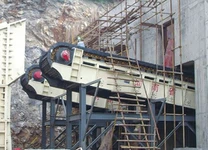
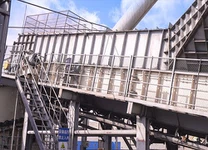
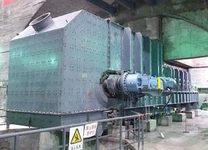
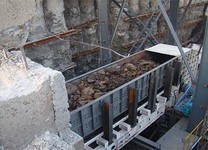
In order to improved type of apron feeder in coal handling plant frame, which belongs to the technical field of feeder manufacturing.
Background technology
The existing technology of angle steel connection, the load-bearing capacity is effective, the structure is not stable, and the structure is complex, the weight of the frame is large, the welding workload is large, and the cost is high.
In order to improved type of apron feeder in coal handling plant frame, the purpose of which is to overcome the above-mentioned defects of the prior art.

The technical solution of the utility model, its apron feeder in coal handling plant structure includes A channel steel, steel rail, bottom plate, B channel steel, oblique support, slide rail, H-beam, A steel plate, A pad plate, B pad plate, A angle steel, C pad plate, roller set, B angle steel, B steel plate; Wherein the slide rail is A steel plate, the steel rail is located on the A steel plate, between the slide rail and B channel steel is H-beam, H-beam and slide rail are connected by oblique support, the bottom of B channel steel is provided with Several bottom plates, the left side of B channel steel is B angle steel, B angle steel and A channel steel connected, the right side of B channel steel is A angle steel, B channel steel with a number of roller group, B channel steel with A pad plate, B pad plate, on each side of the rack has a B steel plate, B steel plate with C pad plate.
The height of the H-steel web is utilized, thus increasing the load-bearing capacity. The apron feeder in coal handling plant rectangular structure is stable, plus the connection of the triangular form of the oblique support, so that a solid form of steel structure is formed between them; 2) On top of the use of materials, due to the simple structure to reduce the weight of the rack, saving materials in 20%; 3) The welding workload is reduced by about 40%, thus saving costs.