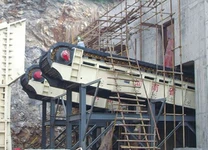
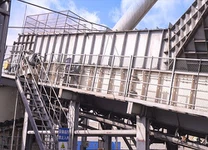
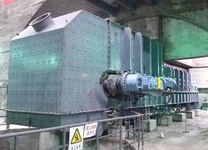
Under the influence of ore impact, the chain pan ofapron feeder in coal handling plant
and the bearings in its supporting roller system are frequently damaged, which leads to frequent failures. This articel applies finite element analysis software to simulate and analyze the ore impact chain pan as well as the support mechanism (the force structure composed of channel steel and I-beam), and learns that during the impact process, the stress at the rigid support of the chain plate is great; the deformation of the chain pan as well as the support mechanism makes the original 5-point support become 2-point support at both ends, which aggravates the damage of the chain plate and the bearings in the roller system. By analyzing the impact characteristics of the chain pan support mechanism of the heavy pan feeder, it has a certain guiding effect on improving the apron feeder in coal handling plant.

apron feeder in coal handling plant is a kind of heavy equipment widely used in mining feeding, its main role is to feed the ore falling from the ore hopper to the upper mouth of the belt conveyor more evenly. In actual production work, the bearings in the chain pan and its supporting roller system are often damaged, making the apron feeder in coal handling plant fail frequently. Through a long period of observation and analysis found that the direct factors affecting the failure of the equipment are mainly 2: First, if the chain pan is pulled empty, the ore will directly impact the chain pan from a height of 10m, the impact is enough to make the chain plate and support roller deformation or even fracture; Second, under normal working conditions, the chain pan liner and the middle part of the support base of the rollers after a period of work (impact) will produce deformation Sinking, resulting in theoretically 5 supporting chain pans per row, but in fact mainly the outer 2 work, shortening the service life of the rollers. The indirect factor is mainly the responsibility of the operating post personnel, the experienced and responsible post will always leave a certain thickness of ore on the surface of the chain plate waiting for the next breakage, which can largely play a buffering role, thus protecting the chain pan. This paper analyzes and studies the impact of ore on the chain pan as well as the support mechanism (I-beam and channel steel), which has a certain guiding effect on improving the apron feeder in coal handling plant.
1. Impact analysis of the chain pan
1.1 Simplified impact model ore from M high free fall (unit: mm) down, the impact on the chain pan and the chain plate is supported by 5 support rollers, 1003265327333 rigid support 8 chain pan by the impact of 3100 hit should Figure 1 impact model force distribution will affect the stress conditions of each support roller, therefore, to analyze the stress distribution of the chain pan after the impact of ore on the chain pan. The ore does a free fall motion with a height of 10m during the whole transportation process, and finally falls on the chain pan. Because the purpose of the analysis is mainly to observe the stress distribution of the chain pan under the impact, therefore, the ore can be regarded as a rigid body and the rigid support roller as a rigid support. In addition, the free fall motion at a height of 10m is equivalent to the vertical falling motion with initial velocity u. The whole impact model is simplified in which M is the ore, and in order to make the analysis more representative, the shape of the ore is set as a sphere with a diameter of d=350mm, whose size and weight are similar to those of the actual ore, so that the stress of the impact is more concentrated. In addition, the rigid support is the support roller, and there is a line contact between the support roller and the chain pan.
(1) During the impact of the ore on the chain pan, the stress at the rigid support of the chain pan is great, which will lead to the destruction of the bearing of the support roller.
And the maximum stress occurs in the middle of the chain pan (impact point) near the range, the stress value exceeds the tensile strength of high manganese steel, which will lead to the deformation and destruction of the chain pan.
(2) The deformation of the chain pan and the supporting mechanism will make the supporting rollers not at the same level, and the 3 supporting rollers in the middle will sink and cannot be supported normally. It causes the shaft on both sides to bear too much force often to fail.
(3) For the support mechanism, the maximum stress occurs at both ends of the support, and the maximum stress value exceeds the tensile strength of 45 steel, which further proves the fact that the actual working support rollers are less than 5, which will aggravate the damage of the wheel system bearings.
As the above is a simplified model, the stress distribution characteristics of the chain plate support mechanism are initially analyzed, while the chain plate support mechanism is also constrained by other aspects in the actual working process, and these constraints will have an impact on its stress distribution, which is also the reason why the stress generated in the simulation analysis is many times larger than the allowable stress.
In practice, buffering can be realized by designing intermediate buffer device and appropriately increasing material thickness, as well as changing work scheduling to avoid the impact damage to the chain plate support mechanism once the chain plate is pulled empty and the material falls directly from 10m high. In addition, ribs can be added on both sides of the I-beam to increase the strength of the I-beam and thus improve its bending resistance. This will prolong the service life of I-beam in the working process of feeder, improve the apron feeder in coal handling plant working efficiency and reduce the economic loss.