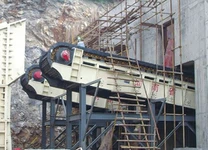
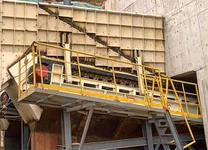
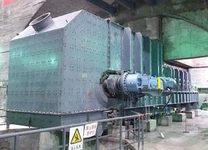
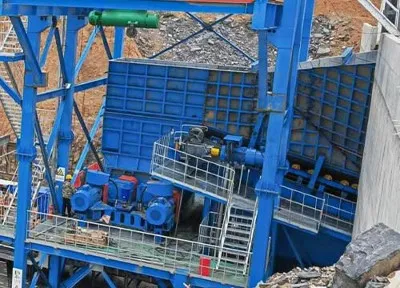
In China, apron feeder mining was introduced by Shenyang Mining Group from the former Soviet Union and Germany in the 1950s and the end of 1980, respectively. Half a century's development made great progress in its structure form, driving mode, control mode, sealing and cleaning effect. However, the theory about its design is still limited to the most primitive simple calculations 3). In particular, the friction between materials, friction between materials and skirt plate and friction between materials and bottom plate have not been paid attention to by special scientific research forces. In the 21st century, some scholars began to study on it theoretically [and made some progress, but there are still many problems to be solved. As apron feeder mining plays an irreplaceable and important role in the mining, metallurgy, chemical industry and port industry, etc., the improvement of its design theory is the important duty for scientific researchers to shoulder.

1. In the literature on layer-pulling phenomenon [5], the concept of layer-pulling was proposed for the first time, and the theoretical formula for the limit height of material conveying in apron feeder mining was deduced. However, the premise of this formula is to assume that layering occurs in the normal transport section and that the material in this section is subject to upward friction, which is not appropriate. Vibration feeders and belt feeders with similar functions are not able to withstand warehouse pressure [6], and there is no problem of carrying limit height. In the actual process setting of mining and other industries, apron feeder mining is directly below the silo, without inclined silo neck, and sometimes in the length direction > The bin opening at 20m is directly connected to the apron feeder mining; So there's a lift height problem. When the active friction force given by the chain plate to a certain section of material is less than or equal to the sum of the friction resistance between the two sides of the section of material and the skirt plate and the material friction resistance given by the upper part of material, the upper part of material cannot move together with the lower part of material, resulting in the phenomenon of layer pulling, as shown in FIG. 1. In FIG. 1, h is the ultimate carrying height. h, the lower part of the material and the chain plate together to move in the direction of v, known as the animal material; , the upper part of the material can not move, called animal material.
Based on the theoretical rules of apron feeder mining from the perspectives of mathematics, rock and soil mechanics and tribology, the limit carrying height of apron feeder mining in normal operation is deduced in this paper. Let z and 6 be the material pressure along the x and y axes, in N/m; A is the cross-sectional area of the silo, the unit is m2; L is the perimeter of the cross section of the silo, and the unit is; f. Is the friction factor between the material and the silo wall; p is the bulk density of the material, in kg/m3; g is the acceleration of gravity, which is 9.81m/s2. y is the height of the material in the silo, expressed in m. The Angle between the four walls of the silo and the horizontal plane is a and 3.
When y≥h is directly below the silo. In order to simplify the difficulty of the integral equation, assume h,=h on the premise of not affecting the understanding. In engineering practice, when h is obtained, h1 is usually set as h in order to save equipment cost and minimize the height of process setting; . It is worth noting that layer-pulling phenomenon can only occur in the first section of material in the apron directly below the silo, and can never occur in the section of normal operation assumed in literature [8]. In short, if there is a layering phenomenon, then the immobile material can only appear right below the bin, and no other force can bring it within 2 stages. In addition, the phenomenon of pulling layer can only appear when the chain plate has just started, the maximum height of the material pulled out of the chain plate is the limit height h. Under this mechanical model, the material in section 1 has no downward movement trend. Therefore, there is no upward friction given by the side plate. In the mechanical model of literature [8], it appears that the material per unit length receives upward friction F3 given by the side plate, which the author believes is wrong.
In practice, most designers pay close attention to every parameter in addition to volume, length, volume weight and climbing Angle; However, in extreme cases, especially the extreme phenomenon that some parameters of large or common apron feeder mining without previous design experience need to be significantly adjusted, there may be ill-considered and design failure phenomenon, which should be avoided. The research results have important guiding significance for the design theory development of large-scale apron feeder mining.