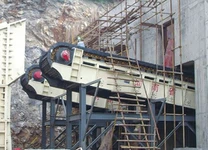
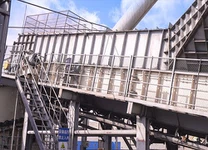
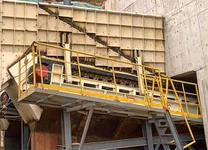
Heavy Duty Apron Feeder buffer chute
When the ore falls from the Heavy Duty Apron Feeder, because the ore itself has a certain weight and the ore has a certain initial speed when the ore is output by the plate feeder, the continuous impact of the ore falling from the feed port of the plate feeder causes serious damage to the belt, resulting in a high frequency of maintenance and replacement of the belt. On the one hand, it restricts the overall efficiency of ore transportation, and on the other hand, it increases the maintenance cost of mining equipment. Therefore, a safe and reliable buffer between the plate feeder and the belt is needed.
Our company provides Heavy Duty Apron Feeder buffer chute, which reduces the speed of ore falling from the feed port to the belt when the plate feeder feeds the ore, thereby reducing the impact force borne by the lower belt, thereby reducing the loss risk of the belt, thereby extending the service life of the belt.

Heavy Duty Apron Feeder buffer chute diagram
1) Working principle:
The ore Heavy Duty Apron Feeder falls to the belt with a vertical drop of 2.5 meters. The ore falling from the feeder's feed port is buffered by the inclined slide plate 3, which is arranged between the feed port and the belt. By shortening the drop of the ore, the impact force of the ore on the belt is reduced, so as to achieve the technical effect of controlling the wear degree of the belt and reducing the accumulation degree of the ore on the belt when the ore is stopped.
Two) Heavy Duty Apron Feeder buffer chute structure
Inclined inclined slide plate and buffer plate arranged between the feed opening and the belt of the plate feeder; The upper end of the inclined slide is connected with the feeding port of the plate feeder; The buffer plate is arranged at the bottom end of the inclined slide, and the buffer plate is arranged parallel to the belt.
The inclined slide can be connected with the feeding port of the plate feeder, or an installation position can be arranged at the feeding port of the plate feeder, and the inclined slide can be installed on the installation position, so that the inclined slide can be directly connected with the feeding port of the miner. The connection mode between the inclined slide and the feeder's feed port can be determined according to the structure of the inclined slide and the feeder's feed port, and there is no restriction here.
Both sides of the upper end of the inclined slide plate are welded inside the feeding machine, and the lower edge is welded with the buffer plate to guide the ore and have a certain buffer effect. The buffer plate is installed on the belt support of the belt to support the inclined slide plate and further alleviate the impact force of the sliding ore.
The buffer plate can be located directly below the exit of the inclined chute, or it can be located directly below the exit of the relative inclined chute, so that the ore at the exit can fall onto the buffer plate.
The buffer plate and inclined slide plate can be installed by welding, and can also be installed by bonding, welding, and screw connection. There is no restriction here. The buffer plate and the inclined slide can be set as one, so that the processing of the buffer plate and the inclined slide is more convenient and the connection is more firm.
An internal concave surface with the ore bearing surface as the inner surface is provided on the inclined slide. The inclined slide and the bearing surface of the ore are formed as one body, that is, the inclined slide is a concave surface with the bearing surface of the ore as the inner surface. That is to say, the inclined slide is bent inward into a curved surface, so as to buffer the transported ore, so as to avoid the effect of beating and splashing during the ore transportation. In order to further increase the effect of preventing ore splashing, a coaming plate extending outwards is provided at the outer edge of the inclined slide.
A buffer plate is arranged at the bottom end of the inclined slide, and the buffer plate is arranged parallel to the belt. In the specific implementation process, the delta 30 manganese steel plate with a horizontal length of 1100mm is welded at the bottom of the chute to act as a buffer plate to support and buffer. When the plate feeder stops feeding, the buffer plate can also block the accumulation of belt ore caused by the small ore block and avoid the flow of small ore.
In order to further ensure the buffering effect, the distance between the buffer plate and the belt is set to 40-70 cm, and the tilt Angle of the inclined slide is 45°-70°. The width of the buffer plate and the curvature of the inclined slide can be determined according to the impact force of drawing.
In order to further increase the buffering effect, a guide plate with equal spacing distribution is arranged on the bearing surface of the ore of the inclined slide. In the process of setting the guide plate, the 22kg/m rail is welded equidistant on the upper surface of the inclined slide plate to make the guide device. The transverse direction of the guide plate on the upper surface of the inclined slide is evenly distributed, and can also be evenly distributed. The number can be 2, 3, 4, etc., and the specific number can be determined according to the length of the inclined slide.
Through the combination of inclined slide plate 3, guide plate 32 and buffer plate 31, the inclined downward impact force of the ore is transformed into a horizontal throwing, avoiding the beating and splashing of the ore during the conveying process, and avoiding the damage of the ore during the conveying process, so as to improve the buffering effect of the conveying ore and the durability of the belt.
In order to further increase the service life of the buffer plate and the inclined slide, the surface of the buffer plate 31 is covered with a cushion and the upper surface of the inclined slide is plated with a high-strength wear-resistant layer. The cushion can be a rubber cushion, and the cushion and wear-resistant layer are not limited to the above structure, only the wear-resistant buffer effect can be achieved.
In short, the Heavy Duty Apron Feeder buffer chute can reduce the damage to the belt through the transformation of the force on the ore; The accumulation of belt ore is reduced by setting buffer plate. Moreover, the materials used can be sourced locally, made simply, and have the technical effect of convenient construction, small labor intensity and small difficulty in construction operations.
3) Heavy Duty Apron Feeder buffer chute technology summary:
1) The combination of inclined slide plate, deflector plate and buffer plate converts the inclined downward impact force of ore into horizontal throwing, reducing the damage to the belt.
2) When the feeder stops feeding the ore, the buffer plate can also prevent the ore from passing through and avoid the ore accumulation of the belt caused by the small ore flow.
3) Reduce belt wear and extend belt life.
4) The structure is simple and practical, with market promotion value.