
In order to improve the work efficiency of compost trommel screen and reduce the energy loss, based on the discrete element theory, a three-factor and three-level orthogonal simulation experiment was carried out on the main factors affecting the work efficiency of compost trommel screen. Through range analysis, the main and secondary order of the influence of various factors on the screening performance was obtained. By comprehensive analysis of the collection rate and screening rate, the best screening performance was obtained when the rotating speed was 32r/min, the height of the sheet was 30mm and the Angle was 5°. The data of 6 groups of single factor test fitting for optimal level scheme show that the utilization rate of roller screen is the highest when the throughput of roller screen is 31.05t/h.
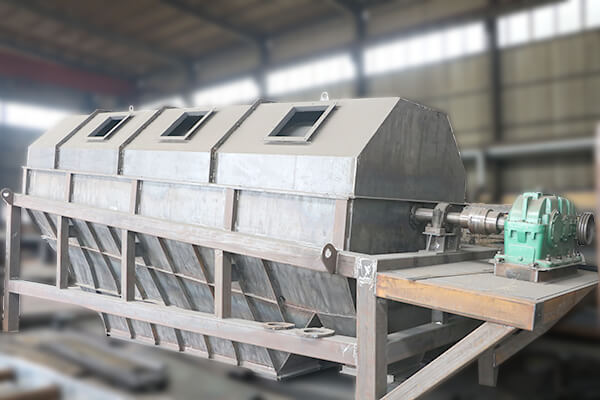
Composting is an effective way to recycle agricultural solid wastes, such as plant residues, crop straw composting, agricultural product processing waste and livestock manure composting to produce organic fertilizer. In agricultural solid waste composting production, the compost trommel screen is mainly used for the separation of composting products and return materials and the classification of finished products, which has a good working effect in composting product treatment. The high efficiency compost trommel screen can not only generate large economic benefits, but also reduce energy consumption, which is important in promoting the reuse of agricultural solid waste. It is found that the working efficiency of the drum screen (that is, the efficiency of screening out the required products is affected by many factors such as the drum speed, the installation Angle of the roll, the processing capacity and the structural design. If the influencing factors are designed unreasonable, it will directly affect the working efficiency of the roller screen.
At present, there are many researches in China. The concept of correction coefficient is introduced in the study of screening machine capacity, and the relationship between actual screening capacity, correction coefficient and design screening capacity is given. The relationship between lifting Angle of material and rotating speed of cylinder is studied from the Angle of force analysis, and it is concluded that lifting Angle of material is not affected by rotating speed and critical rotating speed of cylinder is related to static friction Angle. Motion screening behavior is simulated using the two-dimensional discrete element simulation program Sieve DEM developed for screening.
EDEM was used to study the rotating speed of the roller screen of sea buckthorn fruit removal, and the influence of sieve shape on the separation rate of sea buckthorn fruit removal was explored. By means of control variable method, the influencing factors such as the rotating speed and handling capacity of the mixing refuse roller screen are numerically simulated and the optimization parameters of the mixing refuse roller screen are obtained. At present, most of the research angles are through control variable method, single factor or single factor consideration one by one, while the research methods tend to be discrete element numerical simulation. Discrete Element Method (DEM) is a new numerical method to analyze and solve the dynamics of complex discrete systems. It is mainly used to simulate and analyze the behavior of solid particles by establishing a parametric model of the solid particle system. In recent years, with the improvement of particle model.
Contact model and other mathematical models, software such as EDEM, Yade and LIGGGHTS developed based on discrete element theory has been gradually improved, which makes the application of discrete element in mining machinery, powder engineering and metallurgy more and more widely. The compost particles move along with the rotation of the roller during the working process of the roller screen, and are affected by gravity, friction force and airflow disturbance. Using the discrete element method to simulate and analyze the screening condition of the drum screen particles is beneficial to truly understand the main factors affecting the performance of the drum screen and reduce the blindness of prototype trial production. The orthogonal experimental design of three factors, three levels and two indexes was carried out with the drum rotation speed, drum installation Angle and drum inner plate height as the changing factors, and the collection rate and loss rate as the evaluation indexes. At the same time, based on the discrete element theory, the first discrete element numerical software EDEM was used to simulate the compost trommel screen screening process.


