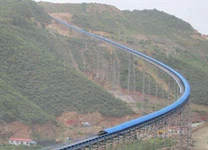
It is planned to build a double-layer belt conveyor that can transport coal and fly ash at the same time from the large coal mine to the Hangkou power plant. The coal will be transported from the coal mine to the power plant, and the fly ash will be brought back to the coal mine for utilization on the return trip.
The top of the double layer belt conveyor covers the height of 2.54m from the ground, the bottom end of the side cover is 0.94m from the ground, the radius of the belt conveyor covers is 1.21m, the height of the flat part of the side cover is 0.82m, the belt conveyor The total width of covers is about 2.40m and the distance between the upper and lower belts is 1.04m. 2.1 Physical model It is difficult to establish a model consistent with the actual belt conveyor due to the complex structure of the belt conveyor, including many internal rolls and support frames. In reference [8-9], the model was simplified, ignoring the roller and support frame in the belt conveyor, and only considering the belt, coal and fly ash area. At the same time, in order to study the influence of crosswind, the outer space of belt conveyor covers is also taken as the calculation domain. Since the flow belongs to three-dimensional flow, three-dimensional modeling was carried out, and the established calculation area was shown in Figure 2. The whole calculation area was 3.59m×3.46m×39m. The two belts in the belt conveyor covers move relative, with a speed of 4.5/s. The movement leads to the difference between the distribution of the flow field in the belt conveyor covers and that in the single-layer belt conveyor covers. The surface of coal pile and pulverized coal pile are the sources of dust. The flow field in belt conveyor covers has a great influence on the flow of dust. Therefore, the flow in belt conveyor covers is mainly considered in calculation. In order to prevent the influence of the inlet and outlet section on the calculation, a longer calculation area is taken along the movement direction of the belt, while a smaller area is taken around the belt to reduce the amount of calculation. Finally, the cross section of the calculation domain established is shown in Figure 2.

2.2 Setting of boundary conditions (1) Continuous phase: In the numerical simulation, the right side of the calculation domain in the surrounding space parallel to the side of the belt conveyor covers is taken as the speed inlet boundary. According to the requirements of coal mine operation, the wind speed is taken as grade 8 strong wind. The corresponding wind speed ranges from 17.2 to 20.7m/s, so the crosswend speed is 17/s in calculation: the left side and the upper side of the calculation domain are both pressure outlets: both ends of the calculation domain are also set as pressure outlet boundaries: the belt is used as moving boundary, and the upper and lower belts move relative to each other at 4.5m/s and -4.5m/s respectively. (2) Discrete phase: coal dust and fly ash dust are both discrete phases and are regarded as inert particles. According to the measured particle size, their distribution belongs to R-R distribution. As can be seen from the upper surface of coal pile and the above table of fly ash, when there is no cross wind, the velocity inside the hood is relatively low, the maximum velocity is less than 0.1m/s, and the velocity outside the hood is less than 0.01m/s. Moreover, the air outside the hood is sucked into the hood, and no dust will be blown out. Because of the influence of strong crosswind (17m/s), a part of the crosswind is blocked below the side of the belt conveyor covers, and a part of the crosswind flows into the cover. Due to the relative movement of the upper and lower transport belts in the cover, a vortex is formed in the space between the two belts, and the entry of the crosswind will strengthen the intensity of the vortex between the two. If the intensity of the vortex is too high, part of the fluid-carried dust particles will flow along the inner wall of the right side of the hood, and then flow out of the hood carried by the crosswind below the hood. In addition, it can be seen that the overall velocity of the area between the upper and lower two belts is relatively small (less than 8/s on average), especially close to the upper surface of coal and fly ash, which is basically less than 5.4m/s. In addition, it should be noted that because the overall height of the belt conveyor covers side is about 1.6m, a lot of wind flows over the belt conveyor covers. The wind speed at the top of the belt conveyor covers can be as high as 55m/s, which forms a huge impact on the belt conveyor covers, which is the problem that should be considered when designing the strength of the belt conveyor covers.