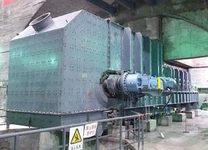
The Apron Feeder serves as the core for material transfer between the silo, hopper, and subsequent crushing and conveying equipment, and is widely used in scenarios such as open-pit mines, beneficiation plants, and cement plants. It assumes the role of the "front-end feeding hub" and can handle heavy materials with a block size exceeding 1 meter and extremely high specific gravity. It is an indispensable equipment for heavy-load feeding scenarios. Its failure and downtime will directly cause the entire production line to come to a standstill.
The bearing capacity, operational accuracy, and service life of this equipment are determined by key components. Mastering the characteristics of each component and selecting them precisely to match the working conditions can avoid frequent failures caused by improper component matching. At the same time, scientific component maintenance can significantly reduce the frequency of replacement of vulnerable parts and downtime losses, thereby improving the overall cost performance of the equipment.
Apron Feeder Working Principle
The driving device drives the head sprocket to rotate, and transmits power through the chain to pull the connected pans to form a continuous conveying surface. Materials fall from the silo onto the pans and are transported in a circular motion to the subsequent equipment, achieving uniform and continuous feeding. Throughout the process, each key component performs its own function and operates collaboratively, jointly ensuring the stability and load-bearing safety of the feeding.
The frame serves as the base to support all components. The drive unit provides power. The sprocket and chain transfer power. The pan directly carries the materials. The bearing wheel group ensures the running direction. The tail tensioning device regulates the transmission accuracy. Safety components avoid operational risks.
Any malfunction of any component will affect the operation of the entire machine and even trigger a chain reaction of failures.
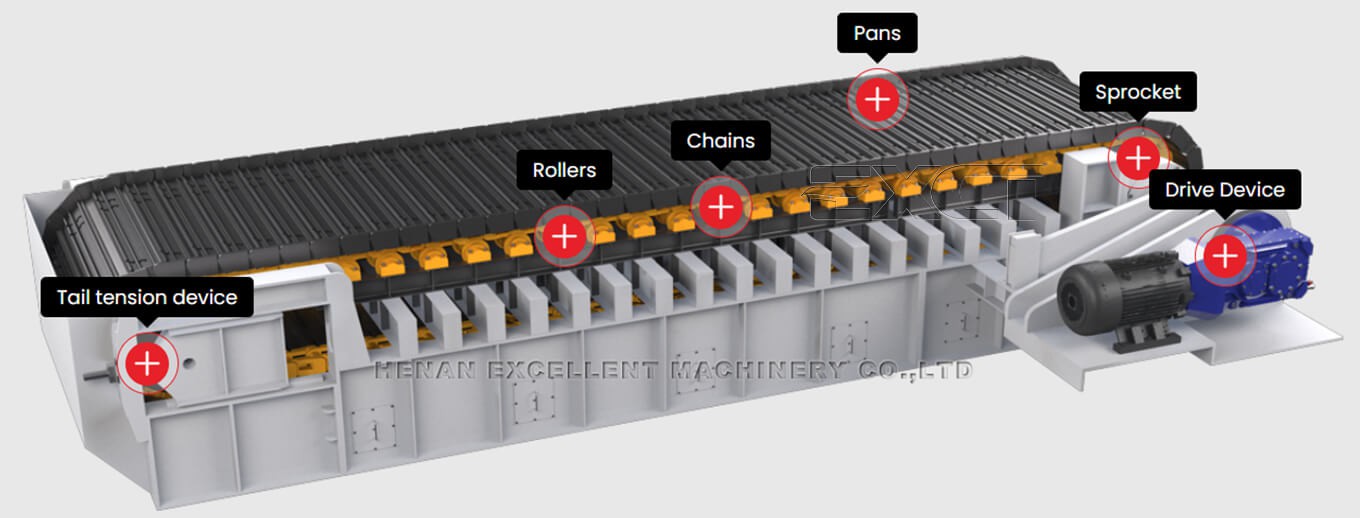
Apron Feeder's 8 Key Components
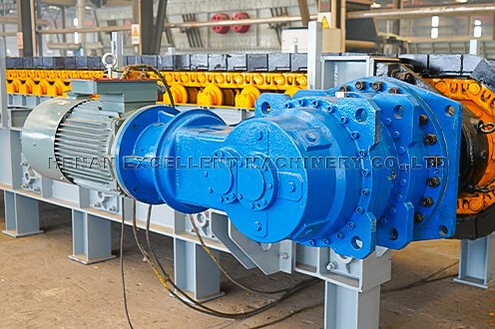
Drive Unit
Drive device utilizes an AC variable frequency drive system that integrates software with electronic and mechanical systems to provide precise conveyor speed control and overload protection.
The main components of the drive device can choose Siemens, ABB, Sew, Flender and other well-known domestic and foreign brands of motor and gearbox, to provide stable and continuous kinetic energy output, with high efficiency, low noise, low vibration and other characteristics.
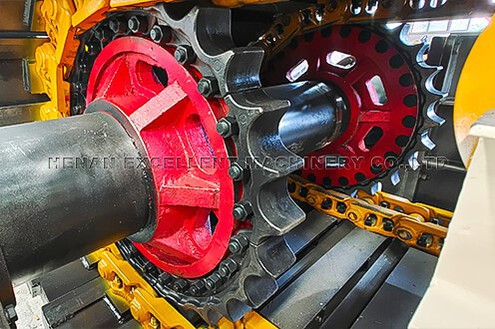
Sprocket
Cast manganese segmental sprockets bolted to heavy steel hubs keyed to oversized front drive shaft.
The segmental sprockets can be replaced in a very short time without needing to dismantle or remove other parts of the feeder.
Pan
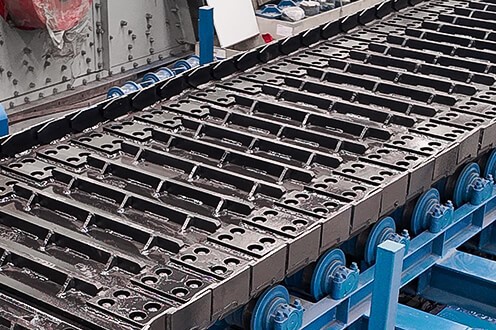
The pans bolted to the chain with high strength bolts and nuts, which can be replaced individually in situ without disturbing the rest of the apron feeder.
According to different working conditions, apron feeder can choose heavy duty cast manganese steel or welded construction with ribbed reinforcements, which is suited for materials with high load and high impact conditions.

Chain
The chain uses an off the shelf dozers chain (Track chain), which is characterized by small pitch error, smooth movement, high strength, large pulling force, and the chain has a self-lubricating device and a sealing device.
Roller
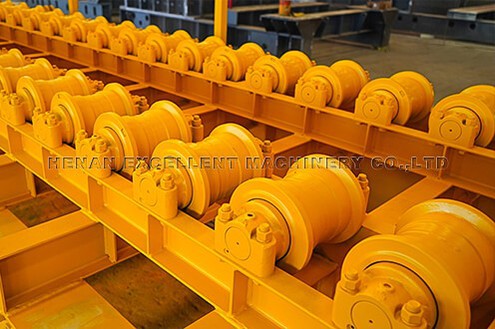
The rollers are designed as a standard tractor rollers with sealed and lifetime lubricated bearings, mounted on the main feeder frame. The rollers has suitably spaced to provide adequate support for the chain assembly.
Tail Tension Device
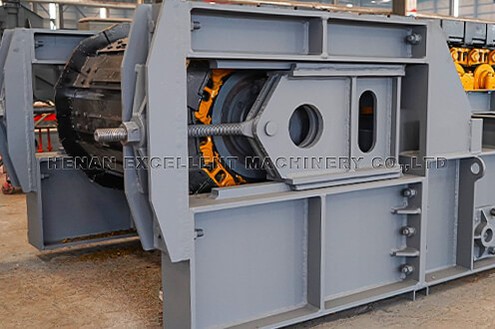
The Tail tension device is used to tighten and adjust the horizontal position of the chain to ensure that the chain tightness is moderate and make it run smoothly.
When the pans are suddenly impacted by the material, the composite spring can play a buffer role to protect the pans and other components from damage.
Frame
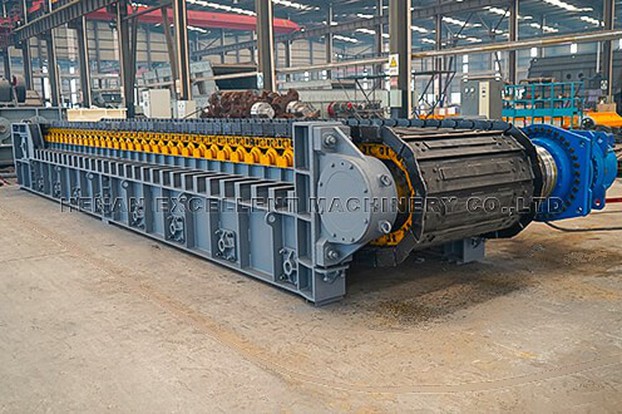
The frame is the "skeleton" of the Apron Feeder, constructed by welding or bolting together components such as the main beam, side beam, legs, and connection flanges. It bears the weight of all the equipment components and the materials.
The material is selected from high-strength steel or steel plates. The welding areas need to undergo flaw detection to ensure the welding strength. The entire structure should undergo aging treatment to eliminate internal stress and possess sufficient rigidity and stability to withstand the impact of heavy materials.
- Core Of Safety Protection: Safety & Auxiliary Components
The overload protection devices (torque limiter, overload sensor) can automatically cut off the power when there is jamming or overload, protecting the core components; the protective cover and baffle can prevent the leakage of materials and avoid personnel contact with moving parts.
The deviation limiters and material level monitoring alarm devices can promptly warn of deviation, excessive/insufficient materials, etc.; the lubrication system regularly adds lubricating oil to the chains, sprockets, idler wheels, etc., reducing friction and wear.
Apron Feeder Key Component Maintenance
Daily Inspection Focus
Daily inspections should include checking the wear of the pans, the tension of the chains, the rotation status of the idler wheels, the operating sound and temperature of the drive device, and promptly clearing the accumulated materials on the components, as well as checking for any loose bolts.
Regular Lubrication And Maintenance
According to the specifications, add the appropriate lubricating oil/lubricant to the chains, sprockets, idler wheels bearings, and the reducer to prevent dry friction and wear. Regularly replace the lubricating oil for the reducer.
Replacement Standards For Wearable Components
When the thickness of the pans exceeds 30% of the original, the pitch of the chains exceeds 2% of the original, the idler wheels become stuck or severely worn, or the tooth surface of the sprocket wears more than 1/3, they should be replaced immediately; if the frame has cracks, the machine should be shut down for maintenance to prevent the expansion of the fault.
Apron Feeder Common Misconceptions
● Misconception 1: The Thicker The Pan, The Better.
Correction: The thickness of the pan should match the load of the material and its wear resistance. If it is too thick, it will increase the self-weight and energy consumption of the equipment. A reasonable thickness combined with wear-resistant treatment can meet the requirements while controlling costs.
● Misconception 2: The Greater The Tail Pull Force, The More Stable It Is.
Correction: Excessive pull force can easily cause overload damage to the chain, bearings, etc. Just ensure smooth engagement between the chain and the chain wheel, and maintain an appropriate tension. There is no need to over-tighten.
● Misconception 3: All Components Need High-end Materials.
Correction: Core load-bearing components (pan, chain, drive device) should use high-quality materials. Non-core components (some auxiliary supports) can use conventional materials to balance cost and service life.
The eight key components of the Apron Feeder work together to jointly determine the equipment's carrying capacity, operational stability and service life. Mastering the structure, function and matching points of each component is the foundation for you to make precise selections and conduct scientific operation.
In practical applications, it is necessary to optimize the component configuration based on the material characteristics, production capacity requirements and environmental conditions. Through standardized maintenance, the risk of faults can be reduced, and the value of the equipment can be maximized, providing a guarantee for the continuous and efficient operation of the production line.
If you have any further requirements regarding the selection of key components for the belt feeder or customized configurations, or if you wish to obtain a feeding equipment solution suitable for heavy industrial conditions such as those in mines and construction materials industries, please feel free to contact us at any time. Our professional technical team will provide you with one-on-one precise consulting services to help your production line achieve efficient, stable, and low-consumption continuous feeding.