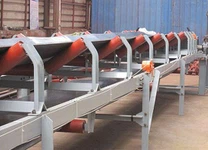
A belt conveyor is a mechanical device that enables the continuous circular movement of the conveyor belt to achieve long-distance and continuous transportation of solid materials (such as blocks, particles, powders, and packaged items, etc.). Its core function is to smoothly and efficiently transfer materials from one node to the next throughout your production, processing, storage, and other processes, serving as the basic equipment for the circulation of industrial materials.
It has a large conveying capacity, stable performance, reliable operation, low cost, strong versatility, and convenient maintenance. It can be widely used in various industries such as mining, metallurgy, construction, transportation, light industry, hydropower, ports, and others. The belt width of EXCT Belt Conveyor can cover 400–2400 millimeters, and the conveyor belt material can be selected from rubber, canvas, steel wire rope core, plastic, or metal, etc., according to your working conditions.

Belt Conveyor Working Principle
The transmission logic of the belt conveyor is not complicated. The core relies on friction to drive.
- After the motor is started, the power is transmitted to the driving pulley. The pulley rotates, and by relying on the friction between it and the conveyor belt, it drives the entire belt to run in a circular manner.
- The materials fall onto the conveyor belt and move smoothly along with the belt, reaching the designated position and completing the discharge.
Compared with conveyor equipment like spirals and scrapers, belt conveyor does not forcibly agitate the materials, causing less damage to the materials, and is suitable for working conditions with specific material requirements.
Belt Conveyor Main Components
Core Component
Belt conveyor is composed of essential components such as conveyor belt, drive device, pulley, idler roller, frame and tensioning device.
The conveyor belt simultaneously performs the functions of traction and load-bearing. The idlers are responsible for supporting the belt and reducing running resistance. The tensioning device is used to ensure that the belt always maintains the appropriate tension and prevent slipping.

Auxiliary Components
Belt scraper, take-up device, conveyor cover all belong to common optional accessories. If you need multiple discharging points or storage bins, you can also add loading and unloading carts and reversible storage bin belt structures.
Safety Accessories
All regular factory-produced Trough Belt Conveyors are equipped with safety protection devices, such as deviation detection, emergency stop, and tear detection devices, to reduce the operational risks on site.
Belt Conveyor Performance Advantages
Large Conveying Capacity
The conveyor belt can be made of high-strength materials such as multi-layer fabric and steel wire rope core, with strong load-bearing capacity, and can stably handle continuous material supply.
Flexible Conveying Distance
The conveying span can range from a few meters to several tens of kilometers, suitable for both short-distance production lines and long-distance mine transportation.
Strong Material Adaptability
It can convey various materials such as hard block materials like ores and sands, as well as cement powder, grain feed, etc.
Stable Operation
The overall transmission structure is simple, and the reliability of continuous operation is high, suitable for 24-hour non-stop production scenarios in industrial and mining sites.
Flexible Layout
You can choose horizontal conveying, uphill inclined conveying, or downhill layout according to the site terrain, suitable for factory height differences.
Simple Maintenance
The parts have a high degree of standardization, making daily maintenance and replacement of accessories convenient, and the maintenance cost for long-term operation is lower.
Conveyor Belt Material Selection
Different materials such as rubber, canvas, steel wire rope core, plastic, and metal belt are available, corresponding to special requirements such as wear resistance, high temperature resistance, and corrosion resistance. In harsh working conditions such as long distances, large transportation capacity, and high dust, EXCT belt conveyor has strengthened structural optimization and component selection to ensure continuous and stable operation.
Belt Conveyors Applications
- Belt conveyors are most commonly used in mining and ports. They are mainly used for the transportation of coal, ores, sand, and slag.
- In power plants, steel mills, and metallurgical workshops, belt conveyors are relied upon to transport fuel, raw materials, and semi-finished products.
- In the building materials, cement, and chemical industries, belt conveyors are widely used to transport powder materials and granular materials.
- In agriculture, food, and feed industries, belt conveyors are also selected to transport grains, raw materials, and finished feed products.
As long as there is a continuous flow of loose materials, belt conveyors can become the preferred conveying solution.

Belt Conveyor Selection
When selecting a belt conveyor, you cannot only consider the equipment price. You need to first clarify your working conditions.
- Firstly, determine the type of materials, particle size, moisture content, and wear resistance. These directly determine the material of the belt.
- Secondly, clearly define the conveying distance, inclination angle of the layout, and the required conveying volume per hour. This is the core for determining the model and drive power.
- Finally, combine the site space to determine the appropriate belt width, and whether a matching discharge device, protective device, or speed control device is needed.
If you are unsure about the parameter matching, EXCT can provide a complete set of conveyor line design based on your on-site conditions.
EXCT Belt Conveyor Customization Service
If you have the need to build, renovate or expand a Belt Conveyor, and are unsure about the selection of belt width, inclination angle and transportation capacity, please feel free to contact us at any time. Send your material characteristics, transportation distance and on-site conditions to the EXCT technical team. We will calculate the parameters for you for free, provide a transportation solution and offer a reasonable equipment quotation. Furthermore, we also offer a one-stop service covering all aspects from scheme design, equipment production, quality inspection, delivery to post-delivery technical support. We will ensure the smooth progress of your conveying project throughout the process.