If you are planning an open-pit mine, construction materials, coal, or port bulk material transfer production line, chances are you will encounter a challenging problem: traditional feeding solutions have high civil engineering investment and are fixed in process, making it difficult to adapt to flexible working conditions such as direct truck unloading and temporary storage areas for material extraction.
Many projects need to pour concrete silos or build steel silos in advance, along with loading platforms and pits, which not only require a large  investment and long construction period, but also make subsequent site adjustments very difficult.
The Surface Feeder was specifically developed to address these pain points and is a heavy-duty feeding and conveying integrated equipment.
What is a Surface Feeder?
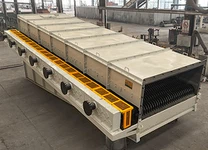
The surface feeder is a heavy-duty feeding equipment that is directly installed on the ground without the need for pits or dedicated discharge platforms. It is mainly used to receive bulk materials directly dumped or pushed over by dump trucks, loaders, and bulldozers, and to complete buffering, uniform distribution, and lifting transportation, and then deliver the materials stably to downstream crushers, belt conveyors, etc.
Unlike ordinary scraper conveyors and traditional apron feeders, the surface feeder integrates functions of receiving materials, buffering, quantitative feeding, and lifting transportation.
You don't need to equip it with a storage bin, nor do you need to dig complex pits. It can eliminate the secondary transportation process of materials, control the construction cost at the source, and make the process layout of the entire production line more flexible.
Surface Feeder Working Principle and Structure
 Working Principle
The main body of the surface feeder is divided into two sections: the horizontal receiving section and the inclined lifting section.
Self-unloading trucks or construction machinery directly dump the materials onto the horizontal receiving section. The heavy scraper chain components inside the equipment can withstand the impact load brought by the material discharge at that moment.
The chain drives the wear-resistant scraper to move the materials at a constant speed, and the materials climb up along the inclined section. They are transported to the downstream main machine at a stable flow rate.
The entire process can reduce the flow fluctuations caused by the truck discharge, achieve continuous, controllable and uniform feeding, and protect the stable operation of the rear-end equipment.
Core Component
Each core component is designed to adapt to heavy-load and strong-impact bulk material working conditions:
- Drive Device: Heavy-load drive unit, supporting variable frequency speed regulation, allowing you to adjust the overall feeding capacity of the machine according to production needs.
- Reinforced Receiving Section: Thickened and reinforced main structure, specifically designed to withstand instantaneous impact from large pieces of material, serving as the first line of protection for the equipment.
- Replaceable Wear Liners: Modular liners are used in concentrated wear areas, allowing for individual replacement after wear to reduce long-term operation costs.
- Heavy-Duty Chain: High-strength, high-tensile load-bearing chain, continuously bearing material impact and conveying tension, suitable for long-term continuous operation.
- Wear-Resistant Flights: Key components directly carrying and transporting materials, with excellent wear resistance.
- Gate: Used to control the thickness of the material layer, allowing for adjustment of the feeding volume and adapting to the processing capacity of the subsequent equipment.
Why Choose Surface Feeder?
Lower Construction Investment
You don't need to build concrete silos, steel silos, pits, or dedicated truck unloading platforms, which can significantly reduce the amount of construction work and shorten the project construction period, resulting in a significant reduction in initial investment.
Direct Feeding
The equipment can directly receive materials from dump trucks, wheel loaders, and bulldozers, eliminating intermediate transfer equipment and reducing the secondary processing steps of materials.
Uniform Feeding
When materials are unloaded by trucks, the material flow fluctuates greatly and the impact force is strong. The Surface Feeder can buffer the impact, stabilize the material flow, and reduce faults in crushers and belt conveyors caused by impact loads.
High Capacity
The standard model has a conveying capacity of up to 2000t/h. If your project has a greater capacity requirement, we can also customize equipment with higher processing specifications according to the working conditions parameters.
Simple Integration
It can easily connect with mineral sizers, belt conveyors, screening equipment, and integrate into your existing crushing and conveying process flow, making it friendly for both new project renovations and existing projects.
Optional Closed Structure
If your site has dust control requirements, you can select a fully enclosed conveying shell to suppress dust leakage during material transportation, meeting the environmental protection standards of mining areas, building materials, and ports.
Surface Feeder VS Apron Feeder
Many customers often confuse surface feeder and apron feeder when making selections. In fact, the corresponding process scenarios of the two are completely different and there is no absolute substitution relationship.
|
Comparison Dimension |
Surface Feeder |
Apron Feeder |
|
Installation Method |
Ground-level surface installation, no pit required |
Generally installed in pits, positioned at the bottom of silos |
|
Feed Source |
Direct dumping from trucks, loaders, and bulldozers |
Material discharge by gravity from overhead silos |
|
Load Characteristics |
Designed to handle instantaneous concentrated impacts, with wider receiving openings and impact resistance as priority |
Primarily subjected to continuous static loads and steady material flow pressure, with relatively lower instantaneous impact loads |
|
Equipment Positioning |
Integrated direct-receiving + feeding unit for pit-free direct-dumping process |
Quantitative discharge equipment downstream of silos, core function is to stabilize silo discharge |


Surface Feeder Application
Operating Conditions
It is widely used in industries such as mining, metallurgy, building materials, coal, and port terminals, and is particularly suitable for flexible receiving scenarios like raw material storage yards and bulk material transfer:
- Truck Dump Feeding
- Stockpile Reclaiming
- Dozer Feeding
- Wheel Loader Feeding
- ROM Coal Feeding
Handling Materials
- Coal: Raw coal, lignite, and other types of coal-bearing bulk materials
- Excavated Materials: Loose soil coverings, mine waste, and overburden waste
- Soft Rock: Limestone, shale, and other moderately hard soft rock materials
- Industrial Minerals: Potash, raw salt, phosphate ore, and other bulk minerals
- Other Bulk Materials: The remaining materials can be evaluated and assessed based on their size, bulk density, abrasiveness, and moisture content for specific purposes
The Surface Feeder is a highly competitive innovative solution in the front-end bulk material feeding process.
Its greatest innovation is that it breaks away from the traditional production line's reliance on silos, pits, and discharge platforms, and is specifically designed for direct truck unloading conditions.
With an integrated receiving, buffering, leveling, and conveying structure, it can help mining, coal, construction materials, and port projects reduce infrastructure investment, shorten construction periods, while retaining the flexibility of process layout.