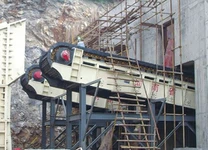
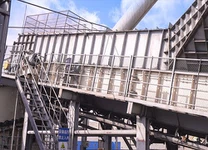
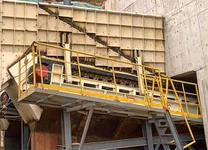
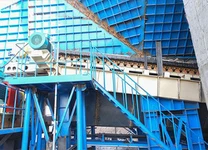
We have been producing all kinds of heavy duty apron feeder for more than 20 years. The speed of all kinds of apron feeder produced before the 1980s is not adjustable, and its chain plate speed is 0.O5m/s, resulting in the limitations of user use. With the expansion of production capacity and the upgrading of downstream machinery, It is required that the upstream machinery, apron feeder, should be adjustable in speed, and the adjustable speed means an increase in production capacity. In order to meet the requirements of users, according to the specific situation of the market at that time, we have adopted several different speed regulation methods.

1.1 Pole change speed regulation
Pole change speed regulation is generally divided into 4/6/8 pole, when the number of poles of the motor is certain, the speed of the motor is also certain, so there is a pole speed regulation rather than the whole process of speed regulation, the use of a small range, there are certain limitations.
1.2 Variable slip rate speed regulation This speed regulation method at low speed, slip rate (1s) is too large, slip loss is also very large, low efficiency. When apron feeder chooses this speed regulation, in order to ensure the reliability of use, the motor power is generally calculated, should be selected first gear, such as the calculation of the motor power is 45KW, the first time should be used 55KW motor. This ensures that apron feeder at low speed is not insufficient power phenomenon, in addition, when the motor is used in metal mines, the iron powder is easy to absorb on the carbon brush of the slip ring, which will cause short circuit of the motor and cause accidents
1.3 Frequency conversion speed regulation The so-called frequency conversion speed regulation is to evenly change the power supply frequency of the motor stator
By changing the power supply frequency of the stator, the speed of the motor can be smoothly changed, and in the speed regulation process, from high speed to low speed, can maintain a limited slip rate, so it has high efficiency, wide range and high precision speed regulation performance, and has sufficient hardness mechanical characteristics, this speed regulation method is widely used.
Variable frequency speed regulation Asynchronous motor in the variable frequency speed regulation in order to keep the power factor of the excitation motor basically unchanged, it is hoped that the track will remain unchanged. If the above three parameters change, there will be a decrease in power, a decrease in torque, and the motor power will not be fully utilized, resulting in waste. Therefore, the track can generally be kept unchanged when the frequency is changed. In order to keep the track unchanged when the frequency is changed, the diameter of the voltage/flyaway rate is required to be fixed, that is, the voltage must change in proportion to the particle rate. As a semi-continuous feeding machine, heavy duty apron feeder has the characteristics of low speed, large torque and starting with material. The speed regulation form is typical constant torque speed regulation. This requires the frequency conversion device to ensure that V1 changes proportionally with 1. Then V1/1= constant, which can ensure that the motor has the same overload capacity in the process of frequency change, when the voltage reaches 100%, the output button moment is the maximum, and the shortcomings of the constant asynchronous motor speed regulation in the rated 50HZ frequency conversion speed regulation due to the decline in speed, so the coaxial connection of the self-cooling fan speed also decreases, the cooling effect decreases. If you do not reduce the capacity of the use, the motor will be due to wet rise and burning accident, inverter output power and power frequency power is different, and the standard asynchronous motor mechanism and performance is designed according to power frequency power, so the ordinary asynchronous motor driven by the inverter will produce high frequency wave, produce interference to the power supply, level factor and so on. Radio interference, motor temperature rise noise and vibration, these problems affect the performance of the motor to varying degrees.
The noise is 1015db higher than the power frequency power supply, and the wiring distance between the motor and the frequency conversion cannot exceed 100m, if it is too long, the reactor can be added between the two to solve the above problems. In addition, there are certain problems with overload protection, the inverter drives a motor, the inherent electronic overheat protection of the inverter can be used, the original is set according to the rated current of the motor, then the motor can be overload protection, when a transformer drives two motors, there are some problems, because each motor has to set protection separately. Generally, a thermal relay is added to the main circuit of each motor. In practical application, we realize that the universal thermal relay with this setting can not effectively protect the motor overload in the whole speed range. The traditional thermal relay is a bimetal structure, according to the size of the current flowing and the time (2, t) to form an inverse time characteristic. Its characteristic curve is only selected for power frequency power supply, only one (corresponding to 50HZ). And the inverter output not only changes the ton rate, but also contains high harmonics. Especially after the cable is extended, the original is not accurate, and it is difficult to fix the thermal relay, because with the change of the color rate, the inverse time curve of the thermal relay also changes. When working at low speed (about 10HZ) the thermal relay works in advance, so that the motor can not work at low speed, we have encountered this problem in the past. Users rarely use the frequency converter, they think that apron feeder should be started at a low frequency, which can protect the machinery from causing certain damage, so it is difficult to start up. Through communicating with us, they understand the performance of the frequency converter, and the problem is solved. If the thermal relay is adjusted for low speed operation, High speed can not protect the use of the motor, in view of the existence of the above problems, it should be preferred to choose a single drive, that is, a frequency converter to drive a motor.
In order to adapt to the requirements of constant torque load (rated frequency 50HZ below the speed regulation), professional manufacturers designed and produced frequency conversion special motor (called VF motor), which is characterized by the frequency conversion speed regulation of the enveloped torque range is suitable for apron feeder speed range, and can be interlocked with the receiving equipment. Realize short-range DCS control.apron feeder constant torque speed control range 220-50HZ. The appearance of frequency conversion special motor not only solves the shortcomings of asynchronous motor in frequency conversion speed regulation, but also expands the use space for mechanical equipment with low speed and high torque constant torque speed regulation. In the design and selection of hydraulic motor speed regulation apron feeder, we also adopt the hydraulic motor speed regulation mode. The working condition of heavy duty apron feeder is low speed and high torque. When applying the hydraulic motor, it also conforms to the working condition requirements of apron feeder, so we choose the plunger type low speed high torque hydraulic motor produced by Sweden Hegelon Company hydraulic speed regulation is characterized by stepless speed regulation and soft starting characteristics. Good shock absorption, is a mechanical and electrical integration of products, but due to the high cost, the price is generally several times higher than the frequency conversion speed regulation, so from the cost consideration, the choice is less.