In your crushing operations, crushing sticky and wet materials is undoubtedly an industry challenge you've encountered. High-moisture feed materials during the rainy season, mud-covered lumps, and low-temperature freeze-thaw sticky materials with high viscosity and a tendency to clump together often cause problems with ordinary crushing equipment, such as roller clogging, material spillage, and crushing chamber blockage. This not only requires machine shutdown and manual cleaning of the crushing chamber, disrupting your production chain, but also increases the equipment load due to material adhering to the roller surface, exacerbating wear and tear on motors and transmission components, and severely reducing production efficiency. As an equipment technician or purchasing personnel, you may wonder why some Mineral Sizers frequently clog while others can stably handle sticky and wet conditions. This article will break down the complete technical logic behind achieving a low clogging rate for sticky and wet materials.
Why Are Conventional Mineral Sizers Prone To Frequent Clogging?
In many projects during the equipment selection stage, if you only focus on the equipment's production capacity and wear-resistant material, but ignore the crushing principle and cavity structure, the equipment will frequently encounter blockage problems after being put into use. When dealing with wet and sticky materials, the shortcomings of ordinary mineral sizers are mainly reflected in four points:
Limited Crushing Mechanism
Traditional models mainly use compression crushing. All large-sized materials entering the cavity are forcibly crushed. A large amount of sticky fine materials continuously come into contact with the roller teeth, easily adhering to the surface of the roller teeth and gradually accumulating to form a thick layer.
01
Lack Of Screening And Sieving Function
There is no dynamic screening structure. Fine materials smaller than the discharge size must also pass through the roller teeth for crushing. Sticky and wet fine materials repeatedly rub and form clumps, increasing the risk of clogged cavities.
02
No Self-Cleaning Cavity Structure
The inner wall and side plates of the crushing cavity are smooth structures. After the materials adhere, there is no mechanical scraping mechanism. The accumulated sticky deposits continuously accumulate, gradually reducing the material flow space, ultimately causing the material to be scattered and blocked.
03
Defects In Cavity Corner Design
The chute and the corners of the cavity have retention dead zones. Wet materials and mud continuously accumulate and gradually spread towards the interior of the crushing cavity, triggering blockage faults.
04
In addition, the material itself has certain characteristics: When high-moisture and high-stickiness materials encounter water, their stickiness increases exponentially, making them prone to adhering to metal components. Multiple factors combined will repeatedly cause blockage problems in your production site.
6 Major Anti-Blockage Designs For Mineral Sizers
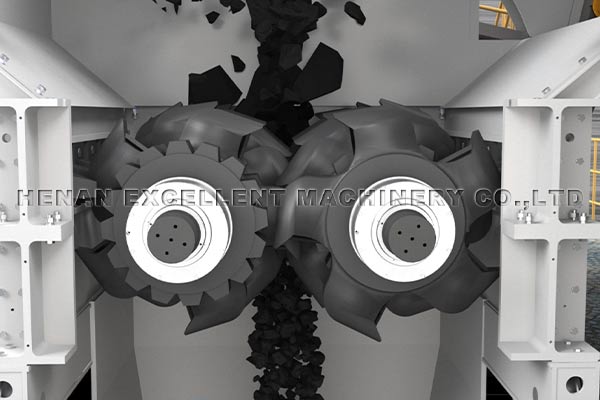
Graded Screening Type Crushing Principle
This is the core underlying logic that makes the equipment suitable for handling wet and sticky materials.
The crushing teeth are equivalent to a set of rotating dynamic sieve screens. After the materials enter the crushing cavity, they will be processed differently:
- Fine and sticky materials that have reached the specified particle size will directly pass through the gap between the teeth and be discharged without participating in shear crushing;
- Only oversized large pieces of materials will be bitten by the roller teeth and crushed by the shear and stretching forces.
A large amount of highly sticky fine materials skip the crushing and rubbing process, significantly reducing the time of material contact with the roller teeth, and fundamentally reducing the probability of clogged rollers and cavities. Compared with traditional models that forcibly crush all materials, the anti-wetness ability of this model is significantly different.
Spiral Staggered Tooth Arrangement
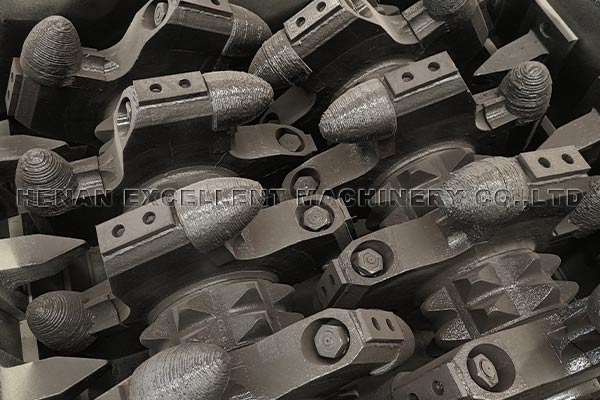
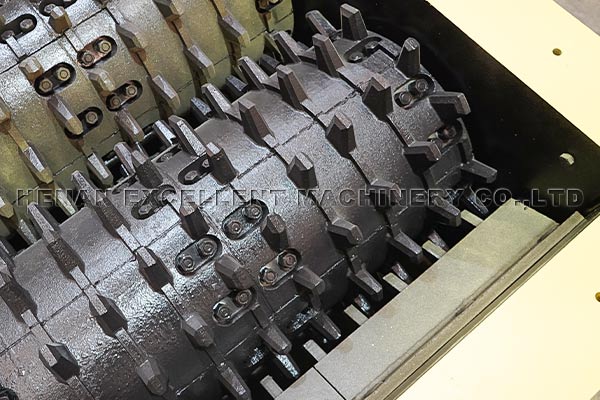
The broken teeth are arranged axially in a special spiral pattern. The double-toothed rollers rotate towards each other. When the toothed rollers are in operation, they can firmly bite large pieces of materials, and at the same time, the teeth can scrape and clean each other, removing the mud and adhesive substances adhering to the tooth surfaces.
Crushing Cavity Side Tooth Plates
Two side tooth plate structures are configured on both sides of the crushing cavity.
Based on the relative rotational movement of the two toothed rollers, the edge gear plate cooperates with the roller teeth to mechanically scrape off the adhesive material adhering to the side wall of the cavity.
This structure enables the equipment to have strong compatibility with the moisture content and clay content of the incoming materials. Within a reasonable working condition, the equipment does not have strict requirements for the moisture content and clay content of the materials, effectively avoiding the blocking of the discharge port by sticky mud.
Adjustable Crushing Beam
Many equipment, in order to control the discharge particle size, will reduce the center distance of the toothed rollers. However, this comes at the cost of compressing the material flow cross-section, and sticky wet materials are prone to get stuck in the gap and cause blockage.
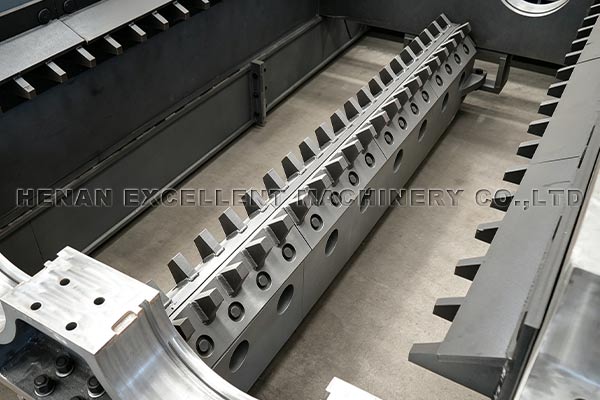
This model sets an adjustable crushing beam below the two toothed rollers to control the discharge particle size.
- By adding or removing spacer plates, the gap between the crushing beam and the toothed roller can be adjusted, allowing for the adjustment of the discharge particle size;
- Without changing the center distance of the toothed rollers, the wide material passage space between the toothed rollers is always retained, avoiding the risk of material blockage caused by narrow gaps.
Crushing beam tooth cap supports individual replacement, and the entire crushing beam assembly can be removed from the body's lower part as a whole. This makes cavity cleaning, maintenance, and disassembly convenient for later use.
Large Center Distance Toothed Roller Design
Take the 2PLF150/300 Mineral Sizer as an example, the center distance of the toothed rollers reaches 1200mm, which is higher than the conventional technical requirements.
The larger center distance of the toothed rollers brings a larger material flow cross-section.
Facing a peak processing capacity of 3000-3500t/h, even if the incoming materials are sticky and wet, the material falling process is not prone to arching or getting stuck, reducing the blockage faults in the high-load production conditions on site.
Three-Level Overload Protection
Even the most excellent structural design cannot completely avoid the blockage caused by hard objects and extremely large pieces of material. The equipment is equipped with a complete electrical and mechanical protection system to provide a fallback for your production.
- Three-level overload protection: Mechanical overload protection for the torque-limiting hydraulic coupling, stall sensor protection, and current overcurrent protection, providing multiple monitoring functions for equipment operation.
- Seizure and Reverse Discharge: When large, sticky, wet materials become stuck, the control system drives the toothed rollers to rotate in the opposite direction, discharging the stuck material without requiring manual entry into the crushing chamber for unblocking.
- Equipment Interlock Control: Once a risk of blockage is detected, the PLC system triggers an interlock shutdown of the upstream feeding equipment to prevent continued feeding from exacerbating material buildup within the chamber.
Supporting System Enhancement
The problem of blocked material is not merely a fault of the crushing chamber itself. Failure of lubrication, equipment failure in low temperatures, can all indirectly cause material accumulation. A complete supporting system can further enhance the stability of your site's operation under sticky and wet conditions.
Automatic Lubrication System
The equipment is equipped with a multi-point intelligent lubrication system. All the bearing lubrication points of the Mineral Sizer 4 are supplied with independent oil supply circuits.
Even if a single oil circuit gets blocked, it will not interfere with the normal oil supply of the other lubrication points. The system is equipped with liquid level monitoring and oil circuit blockage alarm.
For the low-temperature working environment you are in, all the lubricating oil pipelines are equipped with insulation cotton and electric heating, ensuring the fluidity of lubricating grease in the low-temperature environment and preventing bearing lubrication failure and machine stop due to blocked materials.
Modular Cavity Structure
The entire machine adopts a modular design, with clear disassembly of each component of the crushing chamber.
In most working conditions, the self-cleaning structure can maintain smoothness. In extreme abnormal working conditions where a small amount of accumulated material occurs, the modular structure supports quick disassembly and assembly, helping you significantly reduce the time for manual cavity cleaning and lower the downtime losses.
Special Adaptation For Low-Temperature Conditions
For extremely cold working environments of minus 30 degrees Celsius or lower, the equipment is specially designed for low-temperature conditions.
The motor power is approximately 20% higher than that in conventional regions; the hydraulic coupling and reducer use low-temperature-resistant media. This avoids insufficient power output in freezing material conditions, indirectly causing machine stalling and indirectly triggering the problem of blocked materials.
Common Misconceptions Of Mineral Sizer Anti-Clogging
When you are purchasing equipment for a project, you are likely to fall into cognitive traps and end up spending a high cost but still unable to solve the problem of sticky and wet materials blocking the feed.
- Relying On Reducing The Gap Between The Toothed Roller To Control The Output Size
● Incorrect Approach: Reducing the center distance of the toothed roller to control the output size.
● Consequence: The flow space of the materials is compressed, and sticky and wet sludge is easily stuck in the narrow gap, significantly increasing the probability of clogging.
● Correct Approach: Correct Approach: ng models with adjustable crushing beams. Use the crushing beam to control the size and retain the large flow cross-section of the toothed roller.
- Focusing Only On The Wear Resistance Of The Tooth Plate, Ignoring The Crushing Principle
Many purchasers focus all their attention on the wear-resistant material of the tooth cap, believing that wear resistance equals no clogging.
Wear resistance can only extend the lifespan of the wear-prone parts. Whether it can resist sticky and wet clogging depends on the crushing principle, tooth shape arrangement, and self-cleaning structure of the cavity. A purely high-wear-resistant mineral sizer with an extrusion type will still frequently clog the cavity and spill materials.
- Considering The Reverse Function As The Core Of Anti-Clogging
Reverse rotation during a stuck machine is a remedial measure after the failure, not a prevention plan for clogging.
If the crushing principle and cavity design have inherent defects, the materials will continuously clog the cavity, and the reverse function will repeatedly trigger, causing the equipment to frequently start and stop, which will still seriously affect your production efficiency. The core of anti-clogging is to reduce the accumulation of sticky materials at the source, rather than dealing with it after the failure.
Applicable Working Conditions
Our Double Roll Crusher is widely used in various solid material crushing projects. If you have the following production scenarios, it will be highly suitable for your needs:
- ►Your production line needs to handle high moisture and high clay-like solid materials;
- ►Your site experiences damp incoming materials and material clumping during the rainy season;
- ►Your production site encounters problems of frozen and thawed material sticking during winter;
- ►You need to meet a continuous production scenario of 3000-3500t/h.
Take the 2PLF150/300 model mineral sizer as an example. The equipment's inlet particle size can reach 1500mm, and the outlet particle size is ≤500mm. By relying on classification screening + a complete anti-blockage structure, it effectively helps you reduce the frequency of clearing the cavity and stopping due to sticky and wet materials.
If you encounter problems such as sticky and wet materials clogging the cavity during production, frequent material blockage causing mineral sizer to stop and shut down, and want to optimize the crushing system and select the appropriate Mineral Sizer Crusher, please feel free to contact us. You can provide us with information about the properties of the incoming materials, processing capacity, on-site environment, and output particle size, etc. Our technical engineers will provide you with free targeted crushing solutions, equipment parameter evaluations, and technical consultations, helping you effectively reduce equipment downtime losses and improve the stability of the production line operation. We look forward to communicating and cooperating with you!