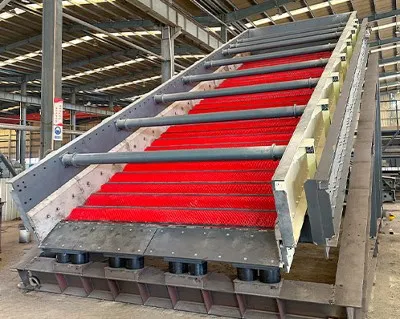
During the production process of a concrete mixing plant, coarse aggregates (crushed stones and pebbles) and fine aggregates (river sand and manufactured sand) are the core raw materials.
Usually, a concrete mixing plant requires four types of transportation methods: Belt Conveyor for transporting coarse and fine aggregates, screw conveyors for transporting concrete and fly ash, forklifts, and concrete delivery pumps. However, these four types of equipment have significant differences in the materials they can handle and their transportation capacities.
Introduction To Aggregate Belt Conveyor
 The special Aggregate Belt Conveyor for mixing stations is a continuous conveying equipment developed for coarse and fine aggregates such as crushed stones, pebbles, mechanically processed sand, and river sand. It is mainly responsible for the automatic transfer of sand and stone raw materials between the silo and the mixing machine, suitable for large-scale and long-term continuous feeding conditions.
The coarse and fine aggregates themselves have high particle hardness and sharp edges, which are prone to wear the conveying equipment. Moreover, the production demand is large, and the coarse materials are prone to rolling down, while the fine sand is prone to dust, spillage, and leakage. The control of material loss is quite challenging. Among the four commonly used conveying equipment in mixing, the belt conveyor has distinct differences in its functions. The belt conveyor can convey various block-shaped and granular sand and stone aggregates, while the screw conveyor is only suitable for cement and ultra-fine powder materials and cannot transfer large blocks of stones. The forklift can only be used for short-term temporary transfer but cannot be connected to the automated production line and has intermittent feeding. The concrete delivery pump can only deliver wet concrete after mixing and is strictly prohibited from delivering dry sand and stone aggregates.
Advantages Of The Aggregate Belt Conveyor
Continuous Large-Capacity Transportation
The single equipment can achieve a maximum conveying capacity of 1280 cubic meters per hour, which can be adapted to both large and small mixing stations; the closed-loop uniform feeding is uninterrupted, allowing multiple sets to be connected in parallel for the synchronous transportation of various aggregates, ensuring stable and balanced production of the production line.
Customized Design Of The Belt
Different belt widths, thicknesses and wear-resistant materials can be selected as needed; combined with V/U type trough idlers to gather the materials, crushed stones and fine sands are less likely to roll off and tear, significantly reducing the probability of aggregate wear and equipment damage.
Flexible Machine Model And Line
There are fixed, mobile, elevating and telescopic models, supporting horizontal and inclined wiring; it can be connected to the central control system to achieve fully automatic unmanned batching, suitable for various production layouts of mixing stations.
 Anti-Slip And Anti-Spread Structure
The belt is equipped with anti-slip patterns, making it less likely to slide during large-angle transportation; combined with trough-type gathering structure and optional stopper skirts, it effectively reduces the scattering of sand and stones along the way, while suppressing dust, meeting the requirements of environmental protection.
Strong Compatibility With The Site
There are both wide-width equipment suitable for large commercial concrete industrial parks and narrow-width small models; combined with rain-proof covers, it can be stably installed in both open-air material yards and indoor batching warehouses.
Comprehensive Automation Support
It can be linked to the entire batching control system to continuously and uniformly supply materials, avoiding the imbalance in proportion and production fluctuations caused by intermittent feeding in the loading workshop, and significantly improving the automation production level of the mixing station.
Aggregate Belt Conveyor VS Other Conveying Equipment
|
Comparison Of Equipment |
Advantages Of Belt Conveyor |
|
Forklift |
Achieves automated continuous conveying, no fuel consumption, less dust, stable and controllable conveying capacity. |
|
Screw Conveyor |
Can convey large pieces of crushed stones and pebbles, has a higher upper limit for conveying capacity, and lower wear and loss of sand and gravel. |
|
Concrete Pump |
Only transports dry sand and gravel aggregates, has no risk of pipe blockage, and can effectively convey over a longer distance. |
Combining the advantages of extremely large continuous conveying capacity, specially customized belts for aggregates, flexible deployment of multiple models, low loss due to anti-slip and anti-spread properties, and compatibility with all specifications of mixing station sites, the belt conveyor perfectly addresses the industry pain points such as high wear of coarse and fine aggregates, easy spillage, and discontinuous supply. It is the indispensable preferred conveying equipment for the transportation of coarse and fine aggregates in commercial concrete mixing stations.
If you are the purchasing manager of a mixing plant or the general contractor of building materials projects, and you need to match a dedicated Aggregate Belt Conveyor based on the specifications of crushed stones, fine sand aggregates, hourly output, and plant layout, please feel free to contact us at any time. We can customize the belt width, thickness, material, and the overall structure of the equipment. We also provide complete equipment technical parameters, site layout plans, installation guidance, and long-term maintenance services.