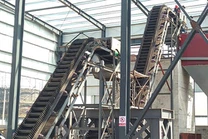
Sidewall belt conveyor is an ideal equipment for conveying bulk materials with high inclination angle, which is widely used in food, chemical, coal, building materials and other industries. Because of the special structure of the conveyor with wavy flange (especially the conveyor belt with t-shaped partition) and the large transmission angle, the unloading track of the head drum can not be designed by the existing calculation equation of the belt conveyor track. The purpose of this paper is to provide a feasible calculation method to draw the discharge trajectory of the particles through the analysis and research of the typical position, so as to guide the reasonable layout of the receiving chute.
1. Calculation model 1.1 of drum discharge trajectory of conventional belt conveyor meets the relation v2(rg)< when belt speed is low; when the band speed is low, the relation v2(rg)< is satisfied; at 1, the material makes a circular movement around the head drum, and after passing the highest point and turning 0 angle, it reaches the point cos0=v2(rg) and separates from the conveyor belt and makes a downward throwing movement, as shown in figure 1-a. Its trajectory equation is as follows: X vtcos0+rsine y= rcos0-vtsine-1/2gt2 in the equation: X - horizontal coordinates /m: Y - vertical coordinates /m; v the velocity of the center of mass of the material at the ejection point /(ms): T time /s; r a material center of mass radius /m; g one acceleration of gravity. 1.2 when the belt speed is high and the relation v2(rg) is ≥1, the material is separated from the conveyor belt at the starting point of the tangent point between the conveyor belt and the roller and is thrown upward, as shown in figure 1-b. Its trajectory equation is as follows:

2sidewall belt conveyor drum unloading edem simulation analysis 2.1 establishment of simulation model and simulation unloading material properties: 20~30mm gravel; conveying conditions: The diameter of the driving drum is 630mm, the thickness of the base band of the corrugated flange conveyor belt is 10mm, the height of the partition board is 140mm, the spacing of the partition board is 250mm, and the height of the skirt is 160mm. Belt speed selection: When v=1.6m/s, v2/(rg)=1.04≈1, which is close to the critical value of the two discharge states, and can more typically understand the material discharge trajectory, so we can choose the common nominal belt speed of 1.6m/s and 2.0ms for research. Under the condition of low belt speed, the drum discharge will produce the phenomenon of material return, we do not consider the case of belt speed less than 1.6m/s; when the tape speed is greater than 2.0m/s, the operation is similar to that of 2.0m/s, and will not be discussed again.
Conveyor angle: The ideal conveyor angle of t-shaped sidewall belt conveyor is between 40° and 50°, when the angle is greater than 50°, the head should be set up horizontal section unloading, so we choose horizontal and 45° angle conveyor for research. (1) horizontal transport: The belt speed of 1.6m/s and 2.0m/s are studied, and the simulated discharge trajectory is shown in figure 2 and 3; in the horizontal conveying state, the unloading trajectories of material particles at each point conform to the unloading trajectories equation model, which can conveniently obtain the unloading trajectories of materials and will not be discussed later. However, the discharge of materials is divergent as a whole, which is different from the discharge track of the conventional flat conveyor belt and cannot be replaced by the transport section centroid track. In the case of low belt speed, there is a small amount of feedback phenomenon, so the design belt speed should be greater than 1.6m/s when horizontal conveying; (2)45° inclination conveying: The belt speed of 1.6m/s and 2.0m/s were studied, and the simulated discharge trajectory was shown in fig. 4 and fig. 5; under the condition of high angle transportation, the upper particles leave the conveyor belt in advance due to the high linear velocity, and the particles in the middle also move to the left and upward gradually until they are thrown out by the partition board. Under the action of the different directions of the partition, the particles at each point run in a chaotic and complicated trajectory. 2.2 analysis of discharge simulation data due to the clear discharge track of horizontal conveying materials, no further study will be conducted; on the contrary, the movement trajectory of material particles in the 45° inclination conveying state is more complex, and the materials are more dispersed, so we will study in this state next. Select research particles: During the operation of the conveyor, materials between two partitions will form a triangle-like accumulation pattern along the conveying direction (from left to right). For convenience of analysis, particles at four typical locations as shown in figure 6 are selected for analysis. For ease of calculation, assume that two ideal particles, 5 and 6, are thrown horizontally from the top of the cylinder at the speed v. Where: Particle 5 is the particle of the material center of the transport section, particle 6 is the particle of the highest point of the material accumulation, particle speed va=(belt speed × the height of the particle from the center of the drum)/ the radius of the drum.
By using edem software to simulate and analyze the typical conveying state and combining with the calculation equation of the discharge track of the conventional belt conveyor drum, a simple method to draw the discharge track chart is obtained, which has a guiding role and reference value for the design of the head guide hopper, the loading chute and the arrangement of the iron remover of the sidewall belt conveyor parts. Can greatly improve the design efficiency. In addition, this analysis method can also be extended to some non-standard conveyor design, such as other types of diaphragm structure of the ripple conveyor and discharge angle greater than 50° conditions.