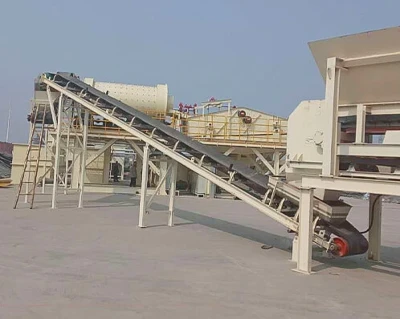
It's the same tubular drag chain conveyor. Some equipment can operate smoothly for ten years, while others stop for maintenance irregularly, dragging down the entire production line?
Many purchasing friends, when comparing equipment, tend to only look at the overall price and ignore the differences in component configurations.
A good tubular chain conveyor is never just a pipe and a chain. It is a closed transportation system where multiple components work together. If any core component does not match your working conditions, problems such as chain breakage, powder leakage, material blockage, and excessive wear are likely to occur.
This article will disassemble the core components of the tubular drag conveyor one by one, explain the function of each component, the material differences, and the selection points. After reading this, you will be able to accurately judge whether the configuration of a device is reliable when conducting procurement negotiations, selecting equipment, or performing daily maintenance.
Tubular Drag Chain Conveyor Introduction
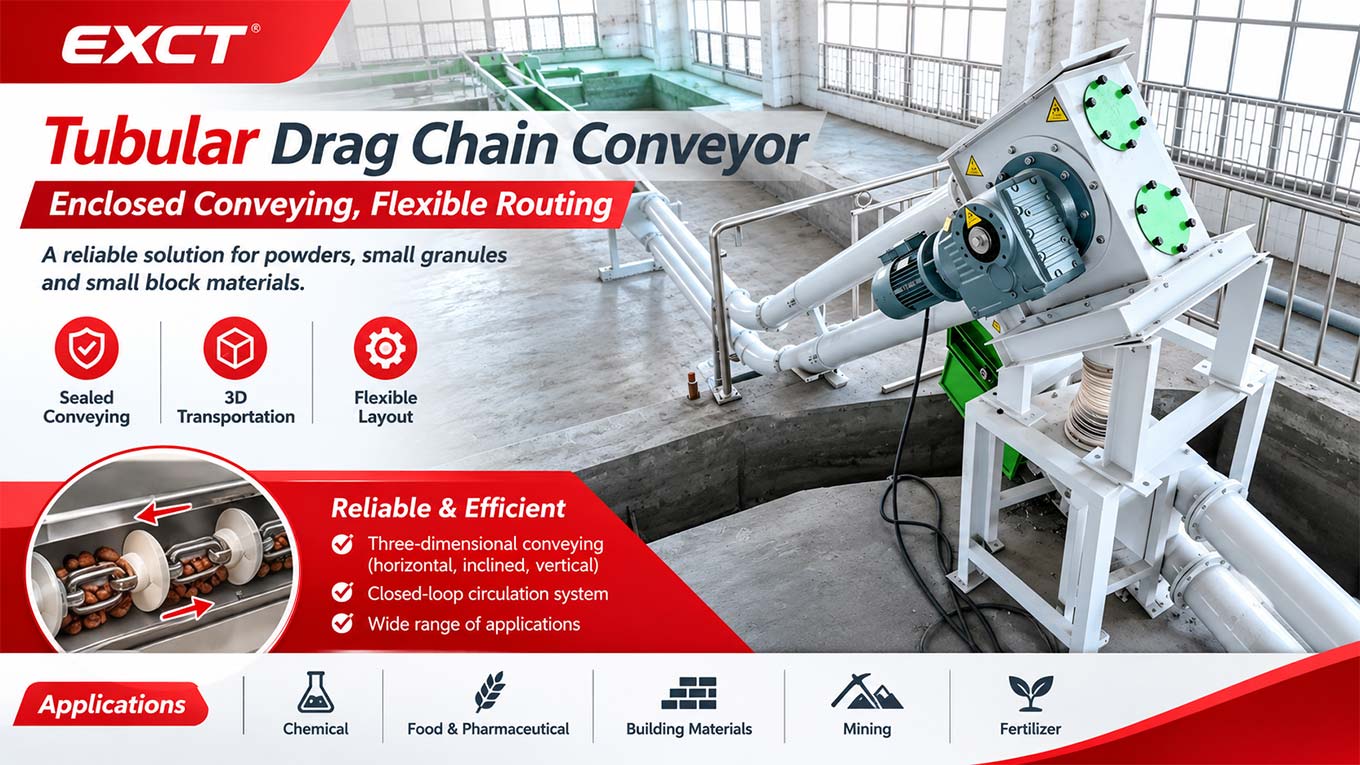
The Tubular Drag Chain Conveyor is a continuous and sealed conveying equipment designed for powdery, small granular, and small block-shaped bulk materials.
It can achieve three-dimensional transportation combining horizontal, inclined, and vertical movements, with flexible and diverse paths. It is widely used in numerous industries such as fine chemicals, food and pharmaceuticals, building materials, mining, and fertilizers.
The entire equipment can be divided into several major parts: the power drive unit, the traction conveying unit, the pipeline and steering unit, the tension adjustment unit, the feeding and discharging unit, the control and safety unit, as well as auxiliary supporting structures such as sealing, maintenance, and support.
The various components cooperate with each other to form a closed-loop circulation conveying system.
Tubular Drag Chain Conveyor Core Component
 Drive Device
The drive device is the power core of the entire equipment, responsible for providing stable power for the chain to rotate.
It is mainly composed of a motor, a reducer, a coupling, and an active sprocket. Electrical energy is converted into mechanical energy by the motor, and then the reducer regulates the speed and amplifies the torque to drive the sprocket to continuously rotate.
When you select the model, you can focus on the following two parts:
- Motor: For normal working conditions, choose a regular motor; if you need to adjust the output, prioritize a variable-frequency motor; in chemical flammable and explosive scenarios, it is necessary to select an explosion-proof motor.
- Reducer: Prefer hard toothed reducers, which have sufficient torque and lower operating noise; for vertical lifting scenarios with material backflow risks, it is recommended to select a reducer with an anti-reversal function.
Power is not necessarily the larger the better. It needs to be comprehensively calculated based on the conveying distance, conveying volume, and material weight to avoid energy waste.
 Conveying Chain
The conveying chain is the core traction component of the tubular drag chain conveyor and one of the main wear-prone parts.
The chain runs in the pipeline in a circular motion, bearing all the tension and driving the disc to push the material forward. Currently, there are two main types: plate chain and ring chain.
- Plate Chain: High tensile strength and strong bearing capacity, suitable for long-distance and heavy-load conveying, such as mineral powder and chemical fertilizers.
- Ring Chain: Better flexibility and strong turning adaptability, often used for small particle materials and multi-turning routes, such as plastic particles and food additives are common.
The wear grade, tensile strength, and corrosion resistance of the chain directly determine the major overhaul cycle of the equipment, which is a key point that you cannot ignore when comparing prices.
 Conveying Disc
The disc is fixed on the chain and directly contacts the material, relying on the disc's thrust to move the material forward in the pipeline.
The disc made of different materials is suitable for different working conditions:
- Nylon Disc: Lightweight and low noise. Food-grade nylon can meet FDA standards and is suitable for food and lightweight powder materials.
- Stainless Steel Disc: Resistant to high temperatures and acid-base corrosion. It is a common choice in fine chemical scenarios.
- Wear-resistant Alloy Disc: Outstanding anti-wear performance, suitable for quartz sand, cement, and other highly abrasive materials.
The disc is a high-frequency loss component. Choosing the wrong material will significantly increase the later replacement cost and downtime frequency.
 Sealed Conveying Pipeline
The sealed pipeline is the storage space for materials, chain, and disc, and is the basis for achieving dust-free and sealed conveying.
There are various options for pipeline materials, and you can choose based on the material properties:
- Carbon Steel Q235: High cost performance, mostly used for ordinary non-corrosive industrial materials.
- 304/316 Stainless Steel: Corrosion-resistant, the preferred choice for food, medicine, and corrosive chemical materials.
- UHMW-PE Ultra-High Molecular Weight Polyethylene: Lightweight and less prone to sticking to materials.
Our pipeline inner walls can also be specially treated: mirror polishing to reduce material adhesion, food-grade Teflon coating to prevent sticking and facilitate cleaning.
Based on the pipeline combination, the equipment can be made into Z-shaped, S-shaped, etc., and easily adapt to multi-layer factories and narrow workshops.
 Corner Box
The role of the corner box is to change the running direction of the chain.
By relying on the steering structure, the tubular drag chain conveyor is no longer limited to linear conveying and can complete horizontal to vertical turns and multi-section inclined turns to meet complex production line layouts.
This is also a major advantage of the Tubular Drag Conveyor compared to other conveying equipment, which can bypass the original equipment in the workshop, saving construction and floor space.
When purchasing, pay attention to the material of the bushing at the steering position. The turning point is the area prone to wear, with poor quality of the bushing, and abnormal wear is likely to occur here.
 Tension Device
The chain will naturally elongate after long-term operation. The function of the tension device is to maintain the appropriate chain tension.
If the tension is inappropriate, there are many potential problems: if the chain is too loose, it will easily jump or break; if the tension is too tight, it will accelerate the wear of the chain, disc, and steering position.
There are two common structures on the market:
- Manual screw tensioning: The structure is simple and the cost is low, suitable for projects with short conveying distance and stable working conditions.
- Automatic spring tensioning: It can adapt to the chain elongation changes, and is more recommended for long-distance conveying and projects with fluctuating working conditions.
During daily maintenance, you need to regularly check the tension status and make timely adjustments.
Tubular Drag Chain Conveyor Working Principle
The tubular drag chain conveyor realizes continuous material transportation through the circular motion of the chain in the enclosed pipeline. The working process is as follows:
Feeding
The material passes uniformly through the feeding device and enters the conveying pipeline, forming a stable material layer distribution in the pipeline.
Chain Drive
After the drive device is activated, the sprocket drives the chain to rotate in the pipeline, and the disc on the chain pushes the material from the feeding end to the discharging end.
Material Advancement
The Chain & disc apply a pushing force to the material, and the material moves along the conveying direction in the pipeline, completing the continuous transfer from the feeding point to the discharging point.
Discharging
After reaching the discharging end, the material is discharged from the pipeline through the discharging device, and the entire conveying process is completed in a sealed space.
Operation Monitoring
The control system monitors the operating status of the equipment in real time, adjusts the conveying speed, and provides feedback on abnormal situations to ensure the stable and continuous operation of the conveying system.
Tubular Drag Chain Conveyor Six Advantages
Full Enclosed Conveying
The pipeline operates in a closed manner throughout, preventing powder and granular materials from leaking or causing dust. This eliminates material loss, improves the workshop environment, and meets the requirements for environmental protection acceptance.
Space Saving
It can be conveyed horizontally, at an angle, vertically, or in Z-shaped, U-shaped, or multi-layer cross-floor combinations, with a small turning radius. It is particularly advantageous in narrow workshops and multi-story factory renovations, reducing construction costs.
Low Material Damage Rate
The chain and disc gently push the material, without high-speed airflow impact or spiral blade compression and shearing, resulting in a low fragmentation rate; mixed materials are less prone to stratification and separation, which is superior to pneumatic conveying.
Good Economy
The entire machine generally only requires one drive motor, and under the same conveying capacity, the energy consumption is much lower than pneumatic conveying, making it economically efficient in the long term.
Flexible Feeding And Discharging
One conveying line can have multiple feeding points and multiple discharging points, easily achieving "one conveyance for multiple divisions, multiple materials merging", facilitating the supply of multiple production lines and the batching of storage groups, simplifying the entire batching and conveying system.
Simple Maintenance
The moving parts are mainly the chain and disc, with few wear parts and easy replacement; the structure reduces dust corrosion of components, and the equipment has a longer service life.
Procurement and Selection
During the procurement stage, do not simply compare prices. You should compare and verify each item according to your material attributes, temperature, corrosion, and explosion-proof requirements, including chain, disc, pipes, drives, and tension devices. For high wear, strong corrosion, and food and pharmaceutical environments, do not blindly choose economical configurations. The savings made in the early stage will often be offset by frequent component replacements and downtime losses later.
For daily operation and maintenance, it is recommended to make these items the focus of regular inspections:
- Whether the chain tension is normal;
- The degree of disc wear;
- Whether there is any abnormal noise at the steering position;
- Whether there is powder leakage at the sealing area;
- Whether the sensor signals are normal.
Regularly keep maintenance records and predict the replacement nodes of vulnerable parts in advance to avoid sudden shutdowns that disrupt production plans.
A tubular drag chain conveyor is not simply a pipe with a chain attached.
Each component is an indispensable part of the conveying system. Only when the configuration and working conditions match can the equipment operate stably and continuously for a long time. An appropriate component solution is the foundation of a reliable Tube Chain Conveyor.
If you need to customize a solution based on material characteristics, conveying distance, production capacity requirements, and factory layout, or if you want to obtain component configuration suggestions for corresponding working conditions, please contact our technical team.