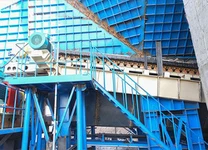
Roller screens are widely used in power plants for coal transportation, coal mines, metallurgy, and construction industries, primarily performing pre-sieving of raw coal, limestone, and other materials to reduce the load on subsequent crushers.
 It adopts an elliptical staggered screen disc structure, with a V-shaped sieve opening formed by concentric screen discs, and a sawtooth-shaped gap between adjacent screen shafts. Materials fall into the V-shaped space of the screen disc and are screened through the relative movement of the screen shaft and the materials. Fine particles fall through the gap, while large pieces are transported to the crusher. Thanks to the friction generated by the relative movement, the screen surface has its own self-cleaning ability, and under normal operating conditions, it is not prone to clogging, with the screening efficiency reaching up to over 90%. Additionally, the EXCT Roller Screen is equipped with a comb-shaped self-cleaning device and an overload alarm protection system, resulting in extremely low failure rates.
Many maintenance personnel may ask: Despite having a self-cleaning structure, why are there still frequent failures on-site? The vast majority of failures are not due to equipment quality defects, but rather arise from abnormal incoming material conditions, improper operation, and inadequate daily maintenance. Once a failure occurs, it will directly trigger overload tripping and unplanned shutdowns, and in severe cases, it can even damage core components such as the reducer and screen shaft, causing significant production losses.
After reading this article, you can quickly identify various typical faults of roller screens, master the on-site practical handling methods, and learn to shift from "post-failure repair" to "prevention-oriented", effectively reducing the frequency of equipment shutdowns.
Roller Screen Common Faults
Screen Shaft Gets Stuck by Large Foreign Objects, Resulting in Decreased or Complete Stopping of Rotation
A single group or multiple groups of screen shafts are obstructed in rotation, with the rotation speed significantly slowing down, and the motor current surges, triggering overload protection and directly tripping.
Causes
Large rocks, iron pieces, wooden parts, etc., hard foreign objects enter the screen surface and get stuck in the screen disc gap, locking the screen shaft from rotating.
Solution Method
- Immediately shut down the machine and cut off the main power supply, and hang the maintenance sign;
- Open the equipment observation door, manually remove the stuck large pieces of debris;
- Manually rotate the screen shaft, confirm that there is no obstruction in the rotation, and then conduct a point test run.
Preventive Measures At The Source
You need to add an iron remover and debris grating at the front conveying system of the Wobbler Screen to intercept foreign objects such as iron blocks and large pieces of wood at the source and reduce the risk of shaft clogging.
The screen surface is tangled and piled with debris, and the material flow is blocked
The coal flow is not smooth, the screen surface is piled with materials, and the comb teeth cleaning device is tangled with a large amount of fabric and fiber-like debris.
Causes
Soft foreign objects such as plastic, fabric strips, and vines in the production system are wrapped around the screen disc and comb teeth, hindering the normal operation of the screen shaft.
Solution Method
After power failure and machine shutdown, clean the screen surface and the various soft debris wrapped on the teeth plate, check if the teeth have deformed or broken, and replace the damaged parts in time.
Key Points Of Daily Inspection
During each shift inspection, you need to focus on checking the teeth cleaning device to avoid debris from accumulating for a long time.
Excessive incoming material flow, wet and sticky materials, causing the entire machine to be clogged and trip the circuit breaker
The material on the screen surface overflows and accumulates, and the equipment processing capacity cannot keep up with the incoming material speed, resulting in frequent alarms and trips.
Causes
The instantaneous incoming material flow exceeds the standard; the raw coal has a high moisture content and is highly viscous, increasing the screening burden.
Solution Method
- Stop the upstream feeding, shut down to clean the accumulated materials on the screen surface;
- Wet and sticky materials can be mixed with an appropriate amount of dry coal to improve the fluidity of the materials;
- Adjust the upstream feeder to reduce the instantaneous feeding volume and ensure uniform and stable feeding.
Suggested Optimization Of Working Conditions
If your site frequently processes high-humidity sticky coal, check the condition of the comb teeth cleaning device to ensure the integrity of the self-cleaning mechanism.
Overload trip due to damaged transmission components
There are no foreign objects on the screen surface, but the screen shaft is difficult to rotate, accompanied by abnormal sounds, and the equipment frequently triggers overload protection.
Causes
Wear of bearings, damage to gears, and failure of the transmission shaft; Inadequate lubrication will further accelerate the wear of components.
Solution Method
After the power outage, the machine was disassembled for maintenance, and the damaged bearings, gears, and transmission shaft components were replaced.
Key Points For Lubrication Maintenance
You should strictly follow the maintenance cycle to add lithium-based lubricating grease to the bearing housing, and replace the gear oil of the reducer according to the corresponding season to avoid dry grinding due to lack of oil.
The upper coal hopper was blocked with materials, causing arching. This indirectly led to the roller screen being overloaded
The Disc Screen load fluctuated frequently, and it was intermittently subjected to a large amount of material impact, resulting in frequent tripping, but the screen surface itself did not get clogged.
Causes:
The accumulated coal inside the feed coal hopper caused arching. The materials would intermittently and in large quantities pour onto the screen surface, resulting in instantaneous overload.
Solution Method
During the shutdown period, clean the accumulated coal inside the coal bunker and remove the arching of the materials.
Optimization Plan
If conditions permit, you can install a crushing device in the coal hopper to improve the stability of material discharge and avoid pulse feeding.
Roller Screen Routine Maintenance
Regular maintenance can significantly reduce the failure rate of the roller screen. The following maintenance items can be directly implemented in the on-site operation system.
 Daily Inspection (Must Be Done Before And After Starting)
- Observe changes in the running current; if the current rises abnormally, stop the machine for inspection immediately;
- Listen for abnormal sounds from the entire machine and monitor the operating temperature of the bearings and reducer;
- Check if there are any foreign objects tangled on the screen surface and if the comb teeth cleaning device is in good condition;
- Check if the sealing cover is intact and if the door is complete, and do not operate with faults.
Periodic Inspection And Maintenance
- Weekly Inspection: Check the tightness of all fasteners, the wear of the chain and chain wheel, and the status of the comb teeth cleaning device;
- Monthly Inspection: Check the wear of the screen disc, and replenish the lubricating oil level of the reducer;
- Annual Inspection: Conduct a comprehensive disassembly inspection of the entire machine, clean and replace the lubricating grease for the bearings, re-tighten all bolts, and check the wear of various sealing components.
Key Points Of Lubrication Management
- Use No. 3 general lithium-based lubricating grease for the bearing housing;
- Differentiate between winter and summer gear oil grades for the reducer and do not mix them;
- For the first 15 days of operation, the oil tank must be cleaned and new oil replaced; subsequently, change the oil every 3-6 months.
Avoiding Faults Through Operating Habits
- Try not to start the roller screen under load; before stopping, completely empty the material on the screen surface;
- Strictly follow the startup logic: start the roller screen first, then start the upstream feeder; the shutdown sequence is to stop the feeder first, clear the screen surface, and then stop the machine;
- Do not remove the comb teeth self-cleaning device at will; it is a key component for resisting coal accumulation.
Roller Screen Safety Guidelines
- When dealing with blockages or maintenance work, always cut off the power supply and hang a "Personnel under maintenance, do not close the switch" warning sign.
- When the equipment is running, do not reach out to clean the screen surface debris; the protective cover and observation door must not be removed without authorization during operation.
- After fault handling, manually rotate the screen shaft to confirm there is no blockage before conducting point operation tests.
- When replacing screen discs, bearings, etc., preferentially use original factory spare parts to ensure the assembly clearance meets the design requirements.
EXCT Wobbler Feeder has excellent self-cleaning and anti-blockage advantages. However, the hardware advantages of the equipment cannot replace standard operation and regular maintenance. The majority of coal blockage and trip faults originate from abnormal incoming material conditions and lack of operation, rather than defects in the equipment itself.
When you encounter equipment failures, you can systematically and step by step troubleshoot and locate the problem by following the sequence of "incoming material conditions → screen surface debris → mechanical transmission → electrical system". This can effectively shorten the fault handling time and reduce production line downtime losses.
If you encounter difficult faults such as coal blockage, overload trip, low screening efficiency during roller screen debugging or operation, or need to customize roller screen equipment, wear-resistant screen discs, bearings, etc. for wet and abrasive conditions, please feel free to contact us at any time. You only need to provide the type of on-site materials, processing capacity, and operating conditions. Our technical engineers will immediately provide you with fault diagnosis, operation plans, and selection and pricing support to help you reduce downtime losses and ensure the stable operation of the production line.