Under the impact of ore, the bearing in the chain plate and supporting roller system of aggregate apron feeders often breaks down, resulting in frequent failures of aggregate apron feeders. In this paper, the finite element analysis software is used to simulate the impact chain plate and the support mechanism (the force structure composed of channel steel and I-steel). It is known that the stress at the rigid support of the chain plate is great in the impact process. The deformation of the chain plate and supporting mechanism makes the original 5-point support become 2-point support at both ends, which intensifies the damage of the chain plate and roller bearing. Through the analysis of the impact characteristics of the supporting mechanism of aggregate apron feeders, it has a certain guiding role in improving aggregate apron feeders.

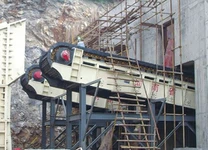
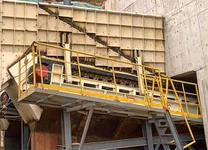
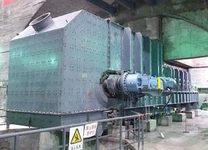
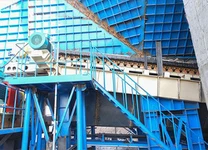
aggregate apron feeders is a heavy-duty device widely used in mines to evenly funnel ore to a belt conveyor. In the actual production work, the bearing in the chain plate and its supporting roller system often breaks down, which causes frequent failures of aggregate apron feeders. Through long-term observation and analysis, it is found that there are two direct factors affecting the failure of aggregate apron feeders. First, if the chain apron is empty, the ore will directly impact the chain apron from a height of 10m, and the impact force is enough to deform or even fracture the chain apron and support roll. Second, under normal working conditions, the middle part of the lining plate of the chain plate and the supporting foundation of the idler will deform and sink after a period of work (impact), leading to the theory that there are 5 idlers supporting the chain plate in each row, but in fact, it is mainly the outside 2 work, which shortens the service life of the idler. The indirect factor is mainly the sense of responsibility of the operators. Experienced and responsible positions will always leave a certain thickness of ore on the surface of the chain plate for the next mine breaking, which can play a buffer role to a large extent, thus protecting the chain plate. In this paper, the impact of ore on chain plate and supporting mechanism (I-beam and channel steel) is analyzed and studied, which has a certain guiding role in improving aggregate apron feeders.
1. Impact analysis of chain plate
1.1 Simplified impact model
The aggregate apron feeders chain plate is supported by 5 supporting rollers, and the stress distribution of the chain plate after the impact will affect the stress condition of each supporting roller. Therefore, the stress distribution of the chain plate after the impact of the ore on the chain plate should be analyzed. The ore in the whole process of transport in a height of 10m free fall, finally landed on the chain plate. Because the purpose of the analysis is to observe the stress distribution of the chain plate under the impact, the ore can be regarded as the rigid body and the rigid support roll as the rigid support. In addition, the motion of a free falling body with an altitude of 10m is equivalent to the motion of a vertical fall with an initial velocity of %. The whole impact model is shown in Figure 1 after simplification. M in Figure 1 is the ore. In order to make the analysis more representative, the shape of the ore is set as a sphere with a diameter of d=350mm. Its size and weight are similar to that of the actual ore. In addition, the rigid support is the support roll, which is in line contact with the chain plate.
1.2 Impact Simulation and Result analysis ANSYS/LS-DYNA finite element analysis software was used for impact simulation analysis. In the pre-treatment of the analysis, the element type of the ore and the chain plate were adopted by Tet-Solid168, which is a 10-node and 30-degree-of-freedom tetrahedral element belonging to the higher order tetrahedral element: The material model of ore adopts rigid body model (igid), elastic modulus E1=48GPa=4.8X101Pa, density p=2.3× 10³kg/m3, Poisson's ratio =0.2: The material of the chain plate is high manganese steel. The material model is isotropic elastic model (I sotropic) in the linear elastic model. Elastic modulus E2=2.1X101Pa, density P2= 7.85×10³kg/m3, Poisson's ratio mountain =0.3. In order to save time, only the process of ore falling from 1m to contact the chain plate is analyzed. Since the ore is in free fall, the initial velocity V0== 13.28m /s(where h'=9 m) is applied to the ore, and the y-direction acceleration is the gravitational acceleration: y-direction constraint is applied to the node at the rigid support of the chain plate. Between the ore and the aggregate apron feeders chain plate are field contact (ASTS). The finite element analysis model is shown in Figure 2. After the current processing is completed, k file is generated and solved by Ls-Dyna Solver of ANSYS/LS DYNA. LS-PREPOST is adopted for post-processing analysis, which can generate the stress nephogram of each output step [). The stress distribution of the chain plate in the impact process can be seen from the stress nephogram of the chain plate. The stress distribution of the chain plate is characterized by the greater stress at the rigid support of the chain plate, and the maximum impact stress is generated on the chain plate at the moment when the ore falls off the plate during the impact process. The maximum stress occurs at unit 6137 at the middle support of the chain plate, as shown in Figure 3. The Y-direction stress curve of unit 6137 is shown in the following figure.