In raw material crushing projects such as those for mines, sand and gravel, coal chemical industry, and thermal power generation, gyratory crushers, hybrid crushers, and mineral sizers are three frequently selected equipment for the coarse crushing stage.
During the early stage of process design for the project, have you ever encountered such a pitfall: only choosing based on the production capacity parameters listed on the equipment nameplate, while ignoring factors such as material moisture content, abrasion index, over-crushing rate, construction investment, and long-term operation and maintenance costs.
After the equipment is put into operation, you will encounter various troublesome problems one after another, such as machine jams, excessive powder content, sharp increase in spare parts consumption, and over-spending on infrastructure budget.
Have you encountered any of the following situations?
- The feed contains clay and high-humidity materials, and you are worried about the crusher getting clogged and jammed
- You need high production capacity while also controlling the proportion of finished powder
- The construction site is limited, and you don't want to invest a large amount of infrastructure costs
- You are worried about frequent replacement of wear parts and long downtime
- You are undecided between double-disc rollers, gyratory crushers, and hybrid crushers
If you fall into any of these categories, the comparative data in this article will be of practical reference value to you.
Three Types of Crushers Working Principles
The principle of fragmentation directly determines the tolerance of a device to different materials, and it is the underlying logic for equipment selection.
Caution: If you are more concerned about the comparison of actual working conditions, you can directly jump to the comparison table below.
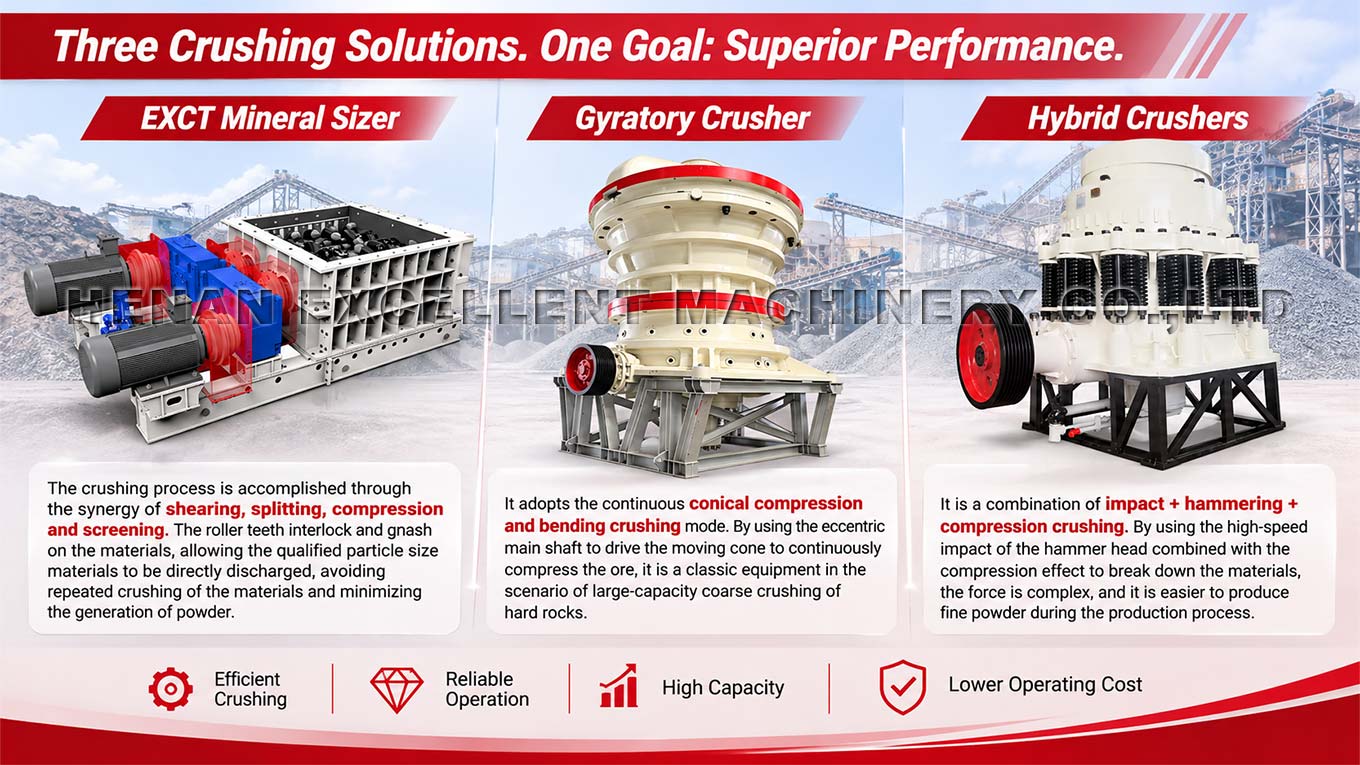
EXCT Mineral Sizer
The crushing process is accomplished through the synergy of shearing, splitting, compression and screening. The roller teeth interlock and gnash on the materials, allowing the qualified particle size materials to be directly discharged, avoiding repeated crushing of the materials and minimizing the generation of powder.
Gyratory Crusher
It adopts the continuous conical compression and bending crushing mode. By using the eccentric main shaft to drive the moving cone to continuously compress the ore, it is a classic equipment in the scenario of large-capacity coarse crushing of hard rocks.
Hybrid Crushers
It is a combination of impact + hammering + compression crushing. By using the high-speed impact of the hammer head combined with the compression effect to break down the materials, the force is complex, and it is easier to produce fine powder during the production process.
EXCT Mineral Sizer VS Gyratory Crusher VS Hybrid Crushers
Based on the actual operation performance on site, this summary is made from multiple aspects such as crushing mechanism, material compatibility, production capacity infrastructure, investment and operation maintenance, to facilitate your quick comparison.
|
VS |
EXCT Mineral Sizer |
Gyratory Crusher |
Hybrid Crushers |
|
Core Fragmentation Principle |
Shearing + splitting + compression + screening and co-crushing |
Continuous conical compression, bending and fragmentation |
Impact + Hammering + Compression combined crushing |
|
Matching Material Hardness |
Suitable for medium to medium-high hardness materials such as coal, limestone, and sandstone; stable operation with compressive strength ≤ 150 MPa, and the short-term peak load can withstand 180–190 MPa |
Mainly targeting hard rocks with high hardness, suitable for high-strength minerals such as granite and iron ore. |
Only suitable for medium-hard materials; severe abrasive hard rock conditions will cause rapid deterioration of wear. |
|
Handling Capacity Of Wet And Viscous Materials |
Outstanding performance, good anti-backflow effect; Clay materials with water content ≤ 20% can be stably produced; Only extremely plastic thick clay in a paste-like form will cause the production to decrease due to sticking of the rollers. |
Poor adaptability, the crushing chamber is prone to clogging with materials, and cleaning operations are frequently interrupted due to equipment failure. |
The performance is average. High humidity of the incoming materials can easily clog the rotor, which affects production capacity and the quality of the output. |
|
After Crushing And Material Output |
The proportion of powder material is low, while the proportion of finished block material is high. |
The degree of pulverization is moderate, and it will produce a certain proportion of fine powder. |
The problem of over-crushing is prominent, and the output of powder material is large. The selection of block material for projects should be cautious. |
|
Single-Machine Production Capacity Range |
The span is large. For medium and small-sized models, the capacity is 50t/h. For large models, it can reach up to 10,000t/h. |
The single-machine production capacity is extremely high, with large-scale equipment capable of reaching several thousand tons per hour. |
The production capacity is generally relatively small, with most models having a capacity of less than 100 tons per hour. |
|
Land Area And Construction Conditions |
The fuselage is compact, the overall height is low, the basic construction is simple, and the cost of the masonry is controllable. |
The equipment is large and heavy, and therefore requires a heavy-duty reinforced foundation. The construction cost is high and the construction period is long. |
The structure is compact, the basic construction is simple, and the investment in civil engineering is relatively low. |
|
Pre-Project Investment |
The overall investment for the equipment is in the medium to low range. |
The initial investment for equipment procurement is very high. |
The equipment investment is at a medium level. |
|
Maintenance And Repair Of Vulnerable Components |
The broken teeth adopt modular tooth heads, which are easy to disassemble, install and replace. Only the worn tooth heads need to be replaced, without the need to replace the entire roller body. |
The weight of the lining plates is considerable, and the process of disassembly, assembly and maintenance is very complicated. The machine needs to be shut down for a long time. |
The hammer head wears out quickly, requires frequent replacement, and leads to a large consumption of spare parts. |
|
Abrasive Material Matching Boundary |
Abrasion index AI ≤ 0.4 is preferred; AI 0.4 - 0.6 is acceptable, but high-alloy tooth heads must be selected; AI > 0.6 is not recommended for long-term use with highly abrasive materials. |
Can stably handle high-erosion mining conditions |
In high-erosion conditions, the wear rate of the hammer head increases rapidly, resulting in poor operational efficiency. |
Actual Project Conditions
|
Project |
Material Conditions |
Processing Scale |
Select The Type Of Equipment |
Project Revenue |
|
Coal Chemicals Coarse Crushing Project |
Raw coal + coal gangue, AI = 0.32, moisture content 16% |
1800t/h |
Wet materials are less likely to clog the machine, resulting in less powder output and lower construction costs. |
|
|
Limestone Sandstone Coarse Crushing Project |
Limestone + sandstone, compressive strength 130 MPa, AI = 0.45 |
4200t/h |
EXCT mineral sizer |
Using high-alloy tooth heads effectively extends the maintenance cycle of the rollers. |
|
Hard Rock Mine Expansion And Renovation Project |
Granite-dominated highly abrasive ore |
5500t/h |
gyratory crusher |
Stable production of hard materials ensures the ability to withstand high construction investment. |
FAQ
Q1: My on-site materials contain both clay and some hard rock. Can the EXCT mineral separator still be used?
A: You need to consider both indicators comprehensively. If the clay does not belong to the highly plastic clay that is prone to hydration slurry, and the proportion of hard rock is not high, and the overall AI erosion index is ≤ 0.6, then by selecting high-alloy roller teeth, the operation can be stabilized. If AI > 0.6, it is not recommended to use it as the main crusher. The engineer can help you assess whether to add a pre-treatment process.
Q2: For the 5000 - 6000 t/h large-scale model, how long will the delivery period be? Will it delay the project schedule?
A: The 5000 - 6000 t/h large-scale mineral sizer is subject to the constraints of key purchased components such as reducers. The overall delivery period is approximately 8 months. If your project schedule is tight, please clearly state the production start date during the consultation, and the engineer can provide alternative production scheduling options.
Q3: If metal foreign objects such as teeth and iron blocks enter the crusher by mistake, how does the equipment provide protection?
A: The EXCT mineral sizer is equipped with multiple safety protections, including thermal protection of the hydraulic coupling, shear protection by safety pins, overcurrent protection in the electrical system, and speed loss protection for the tooth rollers. These multiple mechanisms work in tandem to reduce major damage to the rollers and shafts caused by the foreign objects, and lower the risk of unplanned downtime.
Q4: Can the later-stage spare parts supply for the mineral sizer be guaranteed? Will there be a situation where the tooth heads cannot be purchased?
A: The modular tooth heads, as the core wear parts, are supported by the original factory's complete machine spare parts supply. At the same time, a tooth roller on-site repair solution is available. Overseas projects also support the packaging and shipment of spare parts, so there is no need to worry about a shortage of spare parts.
Q5: How many maintenance hours does the mineral sizer require per year?
A: Each shift requires 0.5 to 1 hour of maintenance. Based on 300 working days in a year, the annual maintenance hours are approximately 150 to 300 hours. Thanks to the modular tooth head structure, there is no need to disassemble the entire roller body, and the major repair time is significantly shorter compared to gyratory crushers.
There is no absolutely best equipment for coarse crushing; only the equipment that best suits the conditions of your project.
If you are in the stage of project selection and are confused about which one is more suitable for you, such as EXCT Mineral Sizer Mining, gyratory crusher, or hybrid crushers. You can provide the relevant operating conditions information and submit it to us. Our professional engineers will compare the adaptability of the three crushers based on the material data and provide equipment selection suggestions, estimated service life of wear parts, and rough calculation of operation and maintenance costs. There is no forced promotion; it is a pure technical assessment.
👉 Consult the engineer immediately to match the operating conditions