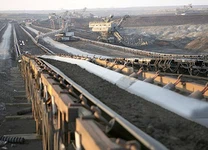
Both are top German brands of hard-toothed transmission. However, their product positioning, torque range, structural forms, and applicable belt conveyor conditions are completely different: SEW focuses on small and medium power, electromechanical integration, and general light / medium-duty belt conveyors; Flender focuses on extremely large torque, heavy-duty independent gearboxes, and long-distance heavy-duty Belt Conveyors for mines / ports.
Comparison Of SEW And Flender Reducer Brands
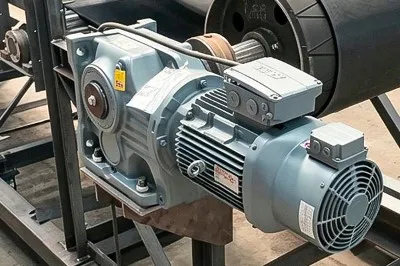
It is a manufacturer specializing in integrated deceleration motors. It adopts a modular design of motor and reducer as one unit, and has R/F/K/M series deceleration motors. The entire machine is equipped with the motor, brake, encoder and cooling fan, providing a complete electromechanical integrated solution. It is suitable for light and medium-sized short-distance belt conveyor applications such as logistics sorting, grains, building materials, short-distance conveyor in workshops, mobile belt conveyor, and lightweight feeding belt conveyor.
Flender Reducer
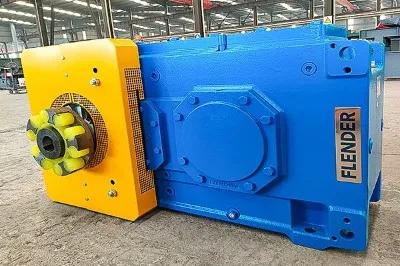
It is a brand under Siemens, mainly producing independent heavy-duty industrial gearboxes. It only produces individual reducer housing, without motors. When used, it needs to be paired with an external independent motor and coupling for drive. The H/B/F series under its brand is specifically designed for heavy-duty conveying scenarios and is the industry benchmark for heavy-duty transmission. It is suitable for heavy-duty long-distance fixed main transportation belts, large-angle belts, and multi-point-driven heavy-duty belts in scenarios such as coal mines, ports, cement, metal mines, and sand and gravel.
Structural Differences Between SEW And Flender Reducers
Overall Structure
- SEW: Integrated drive motor, the motor and gearbox are closely integrated, the entire machine is compact and has a small volume; hollow shaft, contraction disc, and flange output are all available, the base is lightweight.
- Fland: Separate independent gearbox, the box body is heavy, with thick-walled high-strength cast iron / steel plate welding, the volume and self-weight are significantly larger; the box body has extremely strong rigidity, capable of resisting the impact of belt start and stop, and radial force caused by deviation.
Lubrication And Cooling
- SEW: For medium and small-sized machines, splash lubrication is used; for high-power M/ML models, an internal shaft head pump is equipped for forced lubrication, and a standard axial flow fan is provided. The box body has compact heat dissipation fins.
- Fland: For heavy-duty models, an independent external oil pump + water-cooled / oil-cooled radiator is standard. Long-distance belt operation with continuous 24-hour full-load temperature rise control is better; labyrinth + multiple oil seals result in a lower oil leakage failure rate in harsh dust mines.
Installation Form
- SEW: Compatible with all types of installations including horizontal, vertical, side-mounted, and flange suspension. It offers significant advantages for mobile belts and in narrow spaces.
- Fland: Primarily installed with heavy-duty horizontal base, suitable for belt conveyor drive frames and drum bases for large load support; very few are suspended installations.
Comparing Maintenance Costs Of SEW And Flender Reducers
Procurement Price
- Medium and small power: SEW's integrated complete set offers better cost performance and does not require additional purchase of motors and couplings.
- Large power: For the same torque, the independent gearbox of Flender has a lower unit torque cost, making it more cost-effective for large-scale mining projects overall.
Delivery Date
- SEW: The regular R/F/K series has sufficient stock in stock, and spare parts are widely available. The logistics and light belt after-sales service response is fast.
- Fland: The heavy-duty H/B series are mostly customized and have longer delivery times; the spare parts distribution network in the mining and metallurgical industries is complete, but the inventory of general small-sized spare parts is less than that of SEW.
Maintenance Cycle
- SEW: For light-duty belt conveyors, oil replacement is required every 5,000 to 8,000 hours; the integrated structure of the motor and gearbox allows for joint inspection and maintenance, with high requirements for disassembly and assembly space.
- Fland: In heavy-duty conditions, oil replacement is needed every 3,000 to 6,000 hours; the split structure of the gearbox and independent motor make it easier to perform maintenance and replace components without interfering with each other, making on-site maintenance of large Belt Conveyors more convenient.
Belt Conveyor Reducer Selection Comparison
|
Comparison Dimension |
SEW Reducer |
Flender Gearbox |
|
Applicable To Belt Conveyor |
Lightweight / medium-sized, short-distance, mobile belt conveyor |
Heavy-duty long-distance, multi-point-driven belt conveyor for use in mines / ports / cement plants, etc. |
|
Power Range |
0.12 to 3400 kW, mainly medium and low power. |
6 - 4500kW, mainly for high-power and heavy-load applications |
|
Maximum Torque |
Standard 180 kNm |
Standard 1400 kNm |
|
Structural Form |
Motor and gear integrated together, with a compact size |
Independent split gearbox, heavy and rigid housing |
|
Impact Resistance |
Medium, SF = 1.25 - 1.5 |
Extremely strong, dedicated for conveying, SF ≥ 2.0, resistant to material blockage impact |
|
Cooling Lubrication |
Medium-sized splashing lubrication, large-power built-in oil pump |
High-power standard with external oil-cooling / water-cooling forced lubrication |
|
Automation Accessories |
Built-in braking, encoder, bus interface, complete drive system |
Only the gearbox and the electric braking system require additional accessories. |
|
Installation Advantages |
Hanging, vertical, confined space, moving belt |
Heavy-duty base, horizontal installation, heavy-duty drive frame |
|
Typical Scenario |
Sorting belt conveyor, mobile belt conveyor, short-distance feeding belt conveyor |
Coal mine operators use belt conveyors, port loading and unloading use long belt conveyors, and heavy-duty sand and gravel transportation lines are employed. |
If you have any needs such as Belt Conveyor reducer selection, equipment matching, working condition adaptation, purchase quotations, and maintenance consultation, please feel free to contact us at any time. We have a professional technical team that can precisely match SEW and Flandred compatible models for you based on your equipment power, conveying distance, working environment, load requirements, and site installation conditions, thereby avoiding various problems such as improper selection, equipment overload, and cumbersome maintenance.