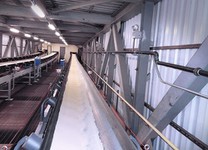
In various construction sites such as infrastructure, housing construction, and road construction, the transportation of sand, stones, bricks, construction waste, and mixed materials during daily operations requires frequent and high-frequency work.
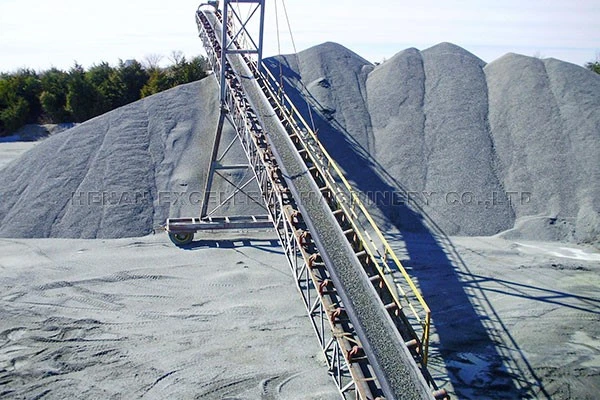
The traditional material handling methods have many problems:
- Manual operation cannot continuously supply materials, resulting in low efficiency, continuous rising labor costs, and frequent accidents due to collisions;
- Fixed belt conveyors require foundation pouring, which occupies a large area and cannot be flexibly moved with the construction site location. It is even more difficult to arrange in narrow pits or basements.
- When there is a height difference between the foundation pit, floor, and storage bin, loaders and small vehicles are restricted in climbing and transporting, unable to smoothly adjust the conveying inclination angle. High drop-off feeding is prone to material rolling and splashing, making it difficult to stably and evenly feed into the mixer or storage bin.
Many construction general contractors, site purchasers, and building material practitioners will wonder: There are many types of conveying equipment on the market. Why has Mobile Inclined Belt Conveyors become the mainstream choice for material transportation on construction sites?
I will analyze from multiple dimensions such as flexibility adaptation, cost control, and equipment structure below to provide you with professional selection references.
What Are Mobile Inclined Belt Conveyors?
Mobile inclined belt conveyors are continuous conveying equipment specially designed for construction sites.
They are equipped with universal wheels at the bottom and do not require a fixed base. They can freely move the conveying point and adjust the lifting height. They are mainly used for short-distance transportation of bulk materials such as sand, gravel, soil, cement mixtures, bricks, etc. from construction waste. Compared with manual handling, they have the advantages of large conveying capacity, high speed, and low labor intensity, which can greatly improve work efficiency.
Mobile Inclined Belt Conveyors Structure & Working Principle
Structure
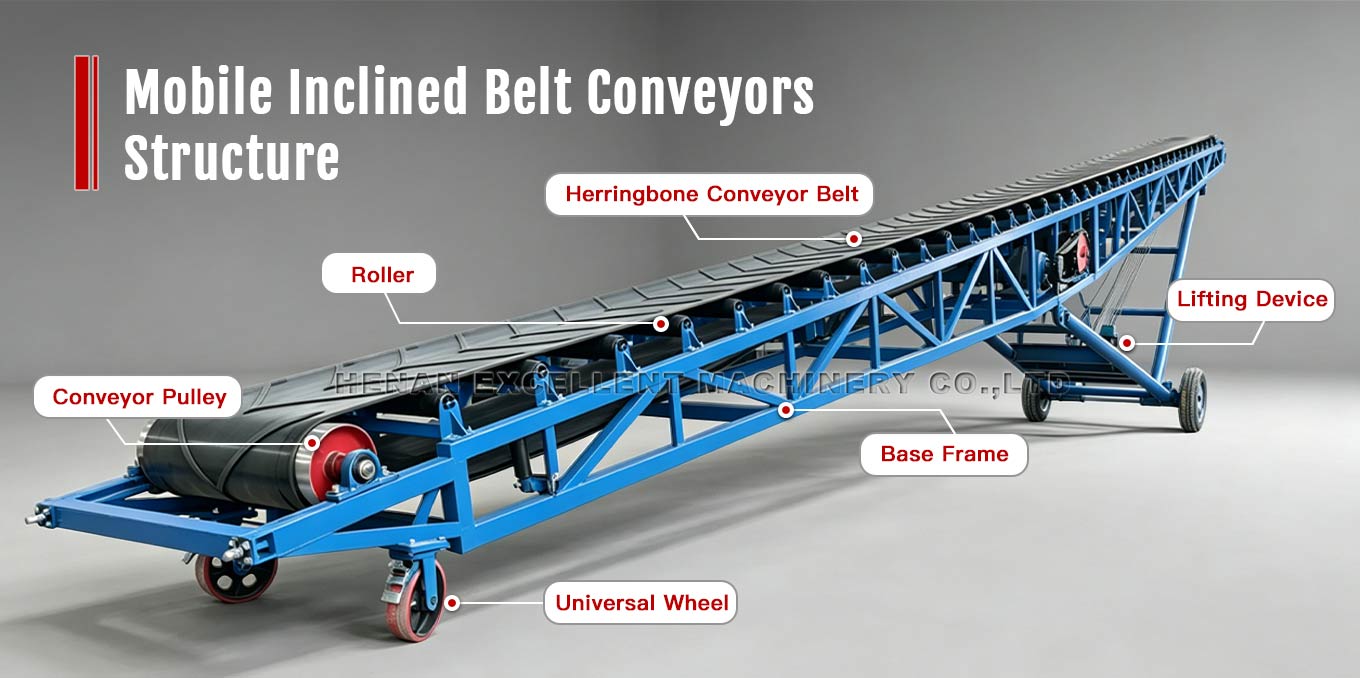
It is mainly composed of a drive device (motor, reducer), conveyor belt (made of rubber or PVC), rollers (drive pulley and bend pulley), idler group, frame and universal wheel.
Working Principle
The working principle is as follows: The motor rotates through the reducer drive pulley, using friction to drive the circular conveyor belt to rotate continuously. Materials fall from the feed end onto the belt and move along the belt to the discharge end for transportation. The equipment can be arranged horizontally or inclinedly according to the working conditions. The maximum inclination angle is usually no more than 22° to prevent materials from sliding. Some models can be equipped with a hydraulic lifting system, which can adjust the conveying height (for example, for construction equipment, it can reach 10 meters), and heavy-duty equipment for ports can even achieve a large inclination angle of more than 30° for transportation.
Why Are Mobile Inclined Belt Conveyors Ideal For Construction Sites?
Can Be Flexibly Moved
The bottom of the equipment is equipped with a high-strength universal wheel, which can be freely moved to the operation point according to the position of the materials stacked, significantly improving the equipment utilization rate. It is highly suitable for construction sites, sand and gravel yards, warehouses, farms, production lines and other scenarios.
01
Adjustable Conveying Angle
The Portable Belt Conveyor can be adjusted according to actual needs. The frame is available in two structures: manual or electric-hydraulic lifting. The adjustable range is from 0° to 30°, fully meeting the requirements for different height operations such as loading materials, stacking, and transferring and feeding.
02
No Need For a Fixed Foundation
Traditional fixed belt conveyors require pre-burial and pouring of the base, which consumes materials and takes a long time. However, the mobile belt conveyor can be put into operation upon assembly, eliminating the need for site renovation. It has a small footprint, and the placement position can be adjusted at any time when the construction period is changed.
03
Efficient Transportation
The use of high-quality wear-resistant and anti-slip rubber conveyor belt ensures strong load-bearing capacity and smooth operation. It can stably transport various block-shaped and granular building raw materials such as sand, stones, mineral powder, cement blocks, and bagged building materials.
04
Easy Operation
It features an electric drive design with low power consumption and low noise. It is equipped with simple operation control buttons, allowing a single person to independently complete the start/stop and lifting/lowering operations of the equipment.
05
Replacing Manual Labor
Manual handling of materials is time-consuming and labor-intensive, and the difficulty of recruiting workers in the construction industry is increasing year by year. A single mobile inclined belt conveyor can replace multiple manual handlers, enabling 24-hour continuous and stable material feeding. Long-term use can significantly reduce labor costs.
06
Multiple Bandwidth Options Available
Based on the volume of your sand and gravel transportation, we offer various widths of belts for selection. Additionally, a discharge chute and a baffle can be installed at the tail of the machine to effectively prevent the waste of materials when loading stones, sand, and gravel powder.
07
Multi-Project Use With One Machine
The overall structure of this equipment is sturdy and the wear-resistant components have a long service life. Construction enterprises and building material leasing companies can purchase a set of equipment and use it for multiple projects. They only need to make a one-time purchase and then use it repeatedly for a long time, thereby spreading out the procurement cost.
08
How To Select The Model Of Mobile Inclined Belt Conveyors At Construction Sites?
Determine The Type Of Conveyed Materials
Based on the properties of different materials (such as temperature, acidity and alkalinity), choose different types of belt materials. Ordinary rubber belts are suitable for common sand, gravel, and dry cement, with applicable environments ranging from -15℃ to 40℃, and the surface temperature of the materials does not exceed 50℃. If the conveyed materials are oily, acidic or alkaline admixtures, or damp and corrosive building materials, plastic belts can be selected, which are resistant to oil and acid and alkali. However, in open construction sites exposed to sunlight, they are prone to aging and slipping during climbing, and a slip-resistant skirt structure needs to be combined.
Select The Appropriate Belt Speed
The belt speed directly affects dust emissions during site transportation, material sliding, and loading effectiveness. It needs to be matched with the type of materials and the loading method:
- For transporting materials with a lot of dust, such as cement powder and gypsum powder, the belt speed should be controlled at 0.8 - 1 m/s to reduce dust dispersion;
- For transporting small-sized aggregates like crushed stones and fine sand, the maximum belt speed can be up to
- The shorter the conveying distance, the greater the inclination angle, and the lower the belt speed should be. When Mobile Inclined Belt Conveyors are wider, a higher belt speed should be selected.
- When using a plow-type discharger, the belt speed should not exceed 2.0 m/s. When using manual batching and weighing, the belt speed should not exceed 1.25 m/s. When using a discharging vehicle, the belt speed generally should not exceed 2.5 m/s.
Volume Of Transportation
The volume of material transportation on the construction site directly affects the selection of the equipment model. The width of the conveyor belt is usually available in 500, 600, 650, 800 mm, 1000, 1200, 1500 mm and other specifications.
- For small-scale renovation sites and small-scale transfer of bagged materials, a narrow belt of 500-650 mm is recommended;
- For large material yards of mixing stations and large-scale transportation of earth and stone materials, belts of 800 mm and above are preferred to ensure continuous supply without congestion.
Conveying Lines
On-site verification of the three core indicators of the site transfer lines: total conveying length, lifting inclination angle (adjustable from 0° to 30°), and height difference between high and low points;
For different working conditions such as foundation pit backfilling, floor material loading, truck loading, and material storage, corresponding machine body length and electric lifting structures can be customized. For narrow basements and indoor construction, compact short mobile belt conveyors can also be customized to adapt to small working spaces.
Based on the above analysis, it can be concluded that mobile inclined belt conveyors, with their core advantages such as the ability to be freely moved, flexible adjustment of inclination angle, no need for pouring fixed foundations, high efficiency and low labor requirements, and the ability to adapt to various specifications for various working conditions, can perfectly solve many problems such as the inefficiency of manual transportation on construction sites, the inability of fixed equipment to be flexibly adjusted, and the difficulty of material transportation with height differences. At the same time, custom matching models can be designed according to different construction sites such as residential buildings, infrastructure construction, foundation pits, and mixing stations, taking into account both short-term construction and the need for multi-project recycling reuse. It is the preferred equipment for material transportation on construction sites that balances construction efficiency and overall cost.
If you are thinking about how to select Mobile Inclined Belt Conveyors that are suitable for various working conditions such as foundation pits, floors, and mixing stations, or if you are unsure about how to determine the belt width, lifting method, and operating belt speed based on the conveyed materials, the height difference, and the site conditions, you can contact us at any time. We can provide you with a customized equipment configuration plan based on your on-site transportation distance, material type, conveying capacity, and height difference. The complete machine is equipped with wear-resistant and anti-slip belts, a movable lifting chassis, and also offers comprehensive factory warranty and installation operation guidance to help you reduce labor transportation costs and improve the efficiency of material transportation on the construction site.