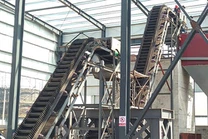
The sidewall belt conveyor refers to the belt conveyor with the inclination angle between 18 and 90 degrees. It is specially designed to transport materials that cannot be conveyed by general belt conveyors and will automatically slide down on the belt, or the space is limited, and only the belt with cleat can be added. With the characteristics of inclination conveying, compact structure and small footprint, it is an ideal equipment for large inclination conveying and vertical lifting of materials.
The biggest feature is that the sidewall conveyor belt is used to replace the ordinary conveyor belt. Its working principle and structure are the same as the general belt conveyor.

The dust removal method of the sidewall belt conveyor with large inclination angle mostly adopts the bag dust removal process of centralized negative pressure suction. In the bag dust removal process, dust capture hood, conveying pipeline, bag filter, induced draft fan and chimney are used. The disadvantage is that the investment is large; the dust collection rate is low; the horizontal pipe is easy to block, which affects the collection rate; the exhaust air volume is large, and the operating cost is high; Large, many branch pipes and long pipelines; there are many valve configurations in the system, and the system air volume balance and adjustment are complicated; full-time operation and maintenance personnel and dust transportation equipment are required.
The biggest difficulty in existing dust removal lies in the collection and transportation of dust. A conical cover is set on the belt guide trough, which is integrated with the dust conveying pipeline. In order to prevent dust from overflowing the collection hood, the material guide must be in a negative pressure state; in order to avoid dust deposition in the pipeline, a large air volume must be used for transportation. Both factors require strong power. Once the dust is deposited in the inside of the pipe, the ventilation efficiency will be greatly reduced, the negative pressure state in the capture hood will be destroyed, the dust will overflow the capture hood, and the capture efficiency will be greatly reduced. The large inclination belt using the bag dust removal process, after running for one or two years, the dust removal pipe is blocked, the dust removal system is paralyzed, and the dust at the dust point is flying. On the other hand, a certain amount of material and dust is deposited between the material guide groove and the corrugated rib. When the belt enters the inclined part, the accumulated material and dust will slide off the base belt bottom plate of the belt, causing secondary dust pollution.
A dust removal system is formed by relatively centralized dust source positions of sidewall belt conveyor or a collection of thousands of dust source points on the same production section. The system pipeline is short, the pipe diameter is small, the equipment layout is convenient, it can be operated intermittently, and the dust removal facilities It can be interlocked with the subject equipment. When there is no pollution, the dust removal system can stop running. The dust is single in nature - easy to recycle and reuse. However, the number of dust removal equipment is large, occupying a certain space, and it is necessary to set up a dust removal device, and the equipment investment is high.
Compared with the centralized dedusting method, the biggest difficulty of decentralized dedusting and dedusting still lies in the collection and transportation of dust. In order to effectively extract air, it is still necessary to maintain negative pressure in the dedusting system, and it is still necessary to operate with large air volume: although the dedusting pipeline is short, the dust Deposits in ducts can still affect the dust removal system's ability to remove dust.