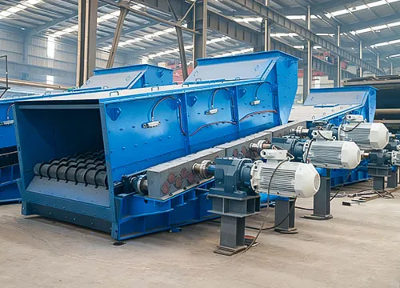
The main features of the flip flow screen we have developed and produced are high screening efficiency, large processing capacity, and simple maintenance. Its screen surface is a specially designed polyurethane flip flow screen plate, which has an automatic cleaning function. It is particularly suitable for wet or damp materials and materials with a small particle size distribution. The screen plate is fixed by rubber wedges, without the need for bolts, and this screen surface has a long lifespan and is easy to replace.
Our Flip Flow Screen is driven by a box-type vibration exciter, also known as a linear drive type flip flow screen. Its characteristics are that the material ejection acceleration on the screen surface is large, the materials are easy to separate and pass through the screen, and the screen holes are not easily clogged. Under this condition, there is always a high screening efficiency, ensuring the demand for raw coal classification in the entire coal preparation process.

Flip Flow Screen Working Principle
- The vibration exciter of the linear drive type flip flow screen consists of two eccentric vibration exciters. The two axes of the linear vibration exciter rotate synchronously but in opposite directions. At any given instant position, the centrifugal inertial forces generated on the two axes in the X-X direction cancel each other out, while the forces in the Y-Y direction always add up, forming a single-directional excitation force along the Y-Y axis, which drives the box to perform linear reciprocating motion.
- It adopts the dual-mass vibration principle, with a single drive generating double vibrations. The first vibration is carried out by a gearbox composed of two eccentric blocks to drive the main frame for linear trajectory movement. The second vibration is the movement of the floating frame driven by the shear spring, which is also a linear trajectory vibration. The flexible screen plate is installed at both ends of the main frame and the crossbeam of the floating frame. It undergoes approximately 800 back-and-forth bending and stretching deformation movements per minute. The throwing intensity can reach more than 10 times that of a conventional vibrating screen, effectively preventing material adhesion and improving the screening efficiency.
Flip Flow Screen Main Components
The flip flow screen is composed of a drive device, screen plate, side plate, screen body, vibration exciter, vibration exciter base beam, cross beam, shock absorption system, shear spring and other accessories.

Key Advantages Of The Flip Flow Screen
High Screening Efficiency
The high acceleration (approximately 50g) of the flexible screen surface enables the screened materials to be thoroughly loosened and separated quickly. Compared with conventional screening machines, a greater amount of fine particles can reach the screen hole openings. As a result, the screen hole passage rate of the screened material is extremely high. The bouncy effect reduces the particle carrying of a part of the screened material on the top.
 No Blockage Of Sieve Holes
The constant flexure effect of the flexible screen plate prevents particle adhesion. The relaxation of the inner and outer screen bodies causes a slight change in the opening of the sieve holes in the tension direction, which can be described as the "breathing" of the sieve holes. Combined with a high acceleration force (about 50g), it prevents particles close to the size of the sieve holes from blocking the sieve holes, solving the world screening problem of wet sticky materials blocking the sieve holes.
Side Plate Anti-Cracking
The screen body is assembled using a full riveting process. All components will undergo stress relief treatment before assembly to avoid stress concentration. The excitation beam adopts a large flange structure to connect with the side plate, effectively distributing the excitation force evenly onto the side plate, ensuring that the side plate will not crack within 10 years.
Screen Plates Stay Secure During Operation
The fixation method of the screen plate adopts a specially designed slot, which has good wear resistance and is not prone to rust or corrosion. The connection between the slot and the crossbeam adopts a self-locking nut and bolt structure, and is protected with Sikaflex glue. Compared with other Flip Flow Screen manufacturers on the market, the fixation of the screen plate in our company mostly uses polyurethane slots, which may cause the screen plate to loosen and fall off in the later stage. This may lead to production suspension or coal from the screen top running to the bottom, affecting the subsequent main washing process and causing economic losses.
Long Service Life
The vibration reduction of the screening machine adopts rubber air springs, which prevents the screening machine from experiencing excessive oscillation during start-up and shutdown (the greater the oscillation during start-up and shutdown, the greater the damage to the equipment). This can effectively extend the service life of the equipment and improve the reliability of its performance.
Easy Maintenance
Apart from replacing the screen plate, the gear oil of the box-type vibration exciter needs to be replaced once every quarter.
Flip Flow Screen Application
The Flip Flow Screen is mainly applied in industrial scenarios where high screening efficiency is required and the material properties are harsh:
- Coal Industry: This is the largest application field of the flip flow screen, used for classifying, dehydrating and de-claying high moisture (more than 10%) fines and coal sludge.
- Mining & Metallurgy Industry: Used for classifying wet and sticky minerals such as iron ore, quartz sand, and bauxite.
- Power Industry: Used for screening the raw coal entering the coal-fired power plant to ensure uniform particle size.
- Environmental Protection Industry: Used for screening and treating urban domestic waste and sludge.
- Building Materials & Chemical Industry: Used for screening materials prone to moisture absorption and agglomeration such as fertilizers, salt, and urea.
From the above content, it can be seen that the Flip Flop Screening Machine, relying on its unique dual-mass dual-vibration mechanism and combined with a high-impact strength polyurethane flexible screen plate, has perfectly solved the problem of clogged holes for wet sticky materials. The screening efficiency is far higher than that of conventional vibrating screens. The equipment adopts optimized structures such as riveted frame, air spring shock absorption, and slot-type screen plate fixation. The side plate is durable, and the screen plate is less likely to fall off. The daily maintenance workload is low. It is widely applicable to the classification and dehydration operations of various high-humidity and easily agglomerated materials such as coal, mining, power, and chemical industries. It is an ideal equipment for efficient screening under harsh conditions.
If you have the need for screening wet and sticky coal, mineral powder, or chemical agglomerated materials, and you want to know about the working principle of the Flip Flow Screen, the selection of models, the matching of production capacity, or if you need to customize a screening plan based on the actual moisture content and processing volume at the site, please feel free to contact us at any time. We can provide parameter calculations for the equipment, as well as exclusive design of working condition solutions, to help you completely solve production problems such as screen hole blockage, low screening efficiency, and equipment wear and tear.