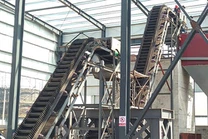
Wavy side conveyor belt is a key part of sidewall belt conveyor. At present, most of the domestic production mode of undulating guard conveyor belt is still based on the traditional rubber conveyor belt, and then the undulating guard and diaphragm are bonded to the base belt, and finally the whole is cured into 28. According to this way manufactured by the wavy side guard conveyor belt in use, there is a general shortage of stiffness. When the sidewall belt conveyor is in operation, it should not only have good tensile strength, but also keep the horizontal state of the belt body, so the horizontal stiffness of the base belt is also required to be high. Due to insufficient lateral stiffness, many undulating side conveyor belts sag at idlers under no-load branches, as shown in Figure 1.5. This not only increases the running resistance of the retaining conveyor, but also intensifies the wear of the undulating retaining conveyor belt. At the change direction of concave and convex arcs, the conveyor belt with wavy retaining edge will have relatively large local forces, so the belt body is prone to transverse deformation. When the deformation is large, the guide wheel will be worn and the roller will wear and beat the diaphragm. In serious cases, the conveyor belt may be detached from the running track at the pressure belt wheel in the convex arc, resulting in shutdown. On the one hand, measures such as improving the transverse stiffness of baseband, increasing the anti-deformation ability of diaphragm, improving the structural form of wavy-shaped baffle conveyor belt and so on can be taken to improve the depression and wear of wavy-shaped baffle conveyor belt, which is also the most important improvement measure for most domestic conveyor belt manufacturers. On the other hand, special supporting devices can be added at the no-load branch, and the five star wheel idlers can be designed by using the basic principle of mutual meshing of gears and rack to enhance the supporting stability of the conveyor belt on the retaining side, greatly reduce the degree of concave and buckling collapse of the conveyor belt on the undulating side side to the middle, and make up for the shortcomings of insufficient transverse stiffness of the conveyor belt. Furthermore, through the optimization design and improvement of the compound idler (guide wheel) device, it can solve the problem that the conveyor belt with wavy retaining edge is prone to deviation and retaining edge wear during operation. This paper will optimize the design and innovation of the corrugable side conveyor belt support idlers, further improve the sidewall belt conveyor, and provide a strong guarantee for the normal operation of the

Sidewall belt conveyor system, which has very important practical significance.
In addition, the service life of the convex rollers in the bearing branch of the undulated retaining conveyor belt is relatively short and the wear damage is serious. Therefore, the research and analysis on the convex rollers in the convex arc section are strengthened, and the failure forms and causes of the convex rollers in the convex arc section are summarized and found, so as to further optimize the design. It plays a vital role in improving the working efficiency of sidewall belt conveyor. Key technologies to be solved in this paper: (1) Improvement of compound idlers (guide wheels). The compound idler (guide wheel) can be placed in the no-load no-load branch bearing wave guard conveyor belt, can also be placed in the heavy load section as a pressure belt wheel. In general, the size of the press wheel of compound idlers is a coaxial body with the same angular speed, resulting in serious wear on the guard edge. The compound idler designed in this paper is a coaxial asynchronous compound idler, to realize the size of the press wheel circumference at the same linear speed, can eliminate the friction between the press wheel and the guard edge, reduce the damage of sliding friction, effectively protect the undulating guard edge.
(2) Failure analysis and optimization design of bearing idlers in convex arcs. Through the physical and chemical analysis, force analysis and shear stress strength analysis of the convex arc bearing roller, the failure forms and failure causes are found, and the targeted optimization design is made to improve the frequent failure and damage of the convex arc bearing roller. (3) Structure design of five star roller. By improving the design of the return roller and using the principle of rack and pail meshing, the five star roller is designed to improve the phenomenon of transverse bending and collapse of the no-load branch of the conveyor belt, improve the supporting stability of the corrugated conveyor belt and extend the service life of the conveyor belt. (4) Finite element analysis and verification. The mechanical model was established by Asys software, and the finite element analysis and verification were carried out on the compound idlers and the five star idlers according to the running condition of the undulating flange conveyor belt, so as to further optimize the design.
There are four main types of layout of sidewall belt conveyor. According to the conveyor has no horizontal section, its layout form is divided into four kinds: only inclined section or straight section is called type I: the lower part has a horizontal section, bearing branch has a concave arc segment, no load branch has a convex arc segment is called L type; The upper part has a horizontal section, and the bearing branch has a convex arc, and the no-load branch has a concave arc, which is called inverse L-type: the upper part and the lower part each have a horizontal section, and the bearing branch and no-load branch both have convex and concave arcs, which is called S-type 2. In the overall layout planning of sidewall belt conveyor, concave and convex arc curve part of the design is the key to the design of the whole conveyor.