

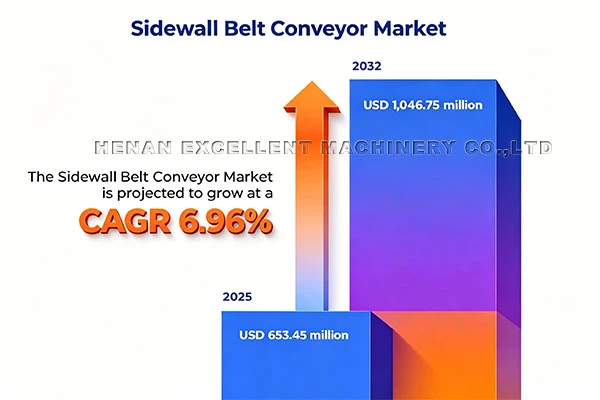
The market size of Sidewall Belt Conveyors is estimated to be 653.45 million US dollars in 2025, and is expected to reach 696.37 million US dollars by 2026, with a compound annual growth rate of 6.96% and reaching 1046.75 million US dollars by 2032.
Sidewall Belt Conveyor Advantages
 The sidewall belt conveyor system is a specially designed material handling equipment designed to overcome the limitations of traditional flat belt conveyors.
Unlike traditional belts that can only be transported horizontally or on gentle slopes, corrugated sidewall belts are mainly composed of a base belt, sidewall, and cleat.
The sidewall is designed in a wavy shape, mainly to prevent the transported materials from sliding and scattering;
the cleat is used to support the materials and help achieve large-angle transportation.
The sidewall and cleat are usually connected to the base belt through a one-time vulcanization method, ensuring a very high connection strength.
Corrugated Sidewall Belt Conveyors can cover the transportation of all materials within 0 to 90 degrees, and are the most technical and economical solution for inclined-angle material transportation.
Sidewall Belt Conveyor Main Application Fields
Sidewall belt conveyors can transport powdery, granular, small block-like, pasty and liquid materials that are prone to scattering. They are widely used in steel mills, ports, sand and gravel plants, foundries, coal plants, mines, chemical plants, fertilizer plants, and other fields.
In Mining Environments:
Sidewall belt conveyors can directly lift the raw ore from the mine pit to the crusher, minimizing intermediate transportation and improving your mining efficiency. This ability to move directly vertically or at a large angle makes sidewall belt conveyors an indispensable tool in industries with limited space or complex terrain.
In Urban Projects:
When you need to transport aggregates such as sand and gravel and need to cross uneven terrain, as well as handle various heterogeneous waste in industrial recycling facilities with compact layouts, Steep Incline Conveyors can meet your needs.
Sidewall belt conveyors can transport food ingredients or pharmaceutical particles at a sanitary and steep angle without causing pollution, highlighting its increasing popularity in the food and life science fields.
Additionally, sidewall belt conveyors improve energy efficiency by eliminating intermediate transfer points, enhancing material sealing, and shortening the conveyor path length, thereby bringing operational flexibility and process simplification to modern production environments.
Strategic Growth Pathways For Sidewall Belt Conveyors
 The end-user segmentation in the Steep Angle Conveyor market highlights the diverse operational needs that drive the adoption of customized solutions.
● Food And Beverage Industry: The conveyors must comply with strict hygiene and disinfection procedures, so food-grade polyurethane conveyor belts are the preferred choice as they can inhibit microbial growth and adapt to the rinsing environment, perfectly matching your industry standards.
● Mining And Quarrying Applications: High-strength, durable sidewall conveyors are required, with high tensile strength and durable rubber compounds, to transport abrasive ores on steep slopes, with conveying distances typically exceeding several hundred meters.
● Packaging Operations: Side wall baffles can be utilized to gently lift fragile cartons and packaging bags through multi-layer sorting lines, and combining the side wall geometry with automated sorting lines to ensure product integrity.
● Pharmaceutical And Life Science Facilities: Industrial-grade electrostatic dissipative PVC conveyors are needed to handle sensitive particles in cleanroom conditions and minimize particle contamination.
● Recycling Plants: Strong neoprene side walls can be used to withstand changes in material types and humidity conditions, while preventing the spillage of broken plastics and metals during the ascent on steep slopes.
Selection Of Conveyor Belt Materials
The selection of conveyor belt materials further optimizes their performance characteristics. Different materials are suitable for different scenarios:
►Polyurethane Conveyor Belts: Available in food-grade and industrial-grade versions, they feature low friction, chemical resistance, and precise plate adhesion, and are suitable for medium-capacity inclined conveyance.
►PVC Conveyor Belts: Industrial-grade (including anti-static type, heavy-duty type) perform exceptionally well in the electronics manufacturing and bulk powder handling industries; food-grade ensures compliance with FDA regulations.
►Epdm Rubber Conveyor Belts: Have thermal stability and oil resistance in high-wear environments.
►Chloroprene Rubber Conveyor Belts: Provide excellent tear resistance and UV resistance for outdoor applications.
This comprehensive research report has clearly segmented the sidewall belt conveyor market into distinct sub-markets, thoroughly analyzed emerging trends, and provided precise revenue forecasts. If you wish to gain a deeper understanding of market trends, accurately select the right solution to meet your industry's needs, or require customized Sidewall Belt Conveyor solutions, please feel free to contact us at any time. We have a professional technical team that can provide you with one-on-one consultation, solution design, after-sales support and other comprehensive services based on your industry scenario and conveying requirements, helping you seize market opportunities, optimize production configuration, achieve cost reduction and efficiency improvement, and achieve steady development.