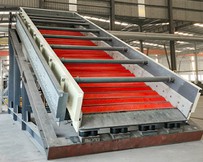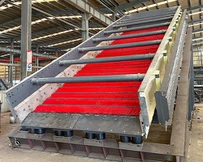


The screening surface of the flip flow screen is usually spacious, reaching several tens of square meters, and can handle a large amount of raw materials. In addition, it has a very high screening efficiency and can complete a large amount of screening work in a short time.
Compared with other screening equipment, this device adopts a special structure and vibration mode, featuring higher output, higher screening efficiency, smaller floor space, stable operation, lower noise, and longer service life, making it more suitable for screening high-density materials.
How Flip Flow Screen Work?
The flip flow screen, also known as the crank and link flip flop screen, operating principle as follows:
Two eccentric wheels with a 180° phase difference enable the screen frames of the system to perform a clear linear reciprocating motion. This means that the crossbeams of the two systems also perform this motion, causing the clamped screen plates to alternately tension and release. This tensioning and releasing action makes the screen mesh, which is mounted across the machine's cross-section, produce a trampoline-like motion, and this is the characteristic feature of the mechanical flip-flow screening machine. The screen mesh's elasticity, resilience, and high wear resistance are key features. The screening machine operates at a low rotational speed, generating a stress of only about 2-3G acceleration. However, the dual - system drive allows the screen panels to achieve a much higher acceleration of approximately 50G.
According to the pre-tension of the screen plate, the acceleration transmitted to the material screening can reach 50G or more. After the screen mesh is finely processed, the pre-tension is adjustable within a certain range.
Flip Flow Screen Structure
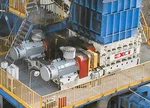
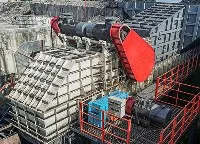
The screening machine mainly consists of a combined screening body (screen frame, flexible screen plate, crank transmission device, end transmission, motor, motor support, screening body support, vibration-damping springs, sealing cover, etc.).
The screen frame is connected by enhanced carbon fiber elastic elements provided by a German manufacturer. These elastic elements remain intact even after millions of reciprocating deflections.
The reciprocating distance between the components is determined by the inherent characteristics of the equipment and does not change with the load size of the screening machine. Therefore, the stability of this type of screening machine is an unparalleled advantage compared to other types of flip flow screens

Flip Flow Screen Details


Key Advantages Of Flip Flow Screen
Self-cleaning Function
The sieve surface is made of high-strength, high-maintenance, and fatigue-resistant polyurethane material. It has precise holes and continuously undergoes high-frequency expansion and contraction during operation. It automatically shakes off the adhered wet and sticky materials, achieving a self-cleaning effect. At the same time, it ensures a long service life even under repeated deformation.
Suitable For Wet And Sticky Materials
This is one of the most significant advantages of the flip flow screen. Its outstanding self-cleaning ability makes it the absolute top choice for processing high-humidity, high-viscosity, and easily clogged-hole materials (such as coal washing products, tailings, sludge, wet mineral powder, sticky limestone, etc.).
Energy Conservation & Environmental Protection
When achieving the same or even higher processing capacity and screening efficiency, the driving power of the flip flow screen is usually lower than that of traditional large-scale vibrating screens, making it more energy-efficient. The efficient screening also reduces resource waste.
Large-scale Processing
The material conveying speed is fast, and the processing capacity per unit area is usually significantly higher than that of traditional screening equipment.
Efficient Screening
Dynamic cleaning ensures high screening efficiency, especially in the classification of small particles and the dehydration of fine particles.
Low Maintenance Requirements
The self-cleaning feature significantly reduces the need for manual cleaning of the screen surface. The modular design of the polyurethane screen surface makes replacement relatively convenient.
Submit your requirements and talk with one of our technical engineer about your project.
Flip Flow Screen Applications
Flip Flow Screen is used in coal, mining operations, aggregate production, metallurgy, transportation, power industry, suitable for dry and wet screening of materials.
|
Processes: |
||
|
Dewatering Screening |
Fine Removal/Desliming |
|
|
Dry Classification |
Discharge Screening |
|
|
Wet Screening |
Secondary Screening |
|
|
Fine wet Screening |
Tertiary Screening |
|
|
Material: |
||
|
Coal |
Sand |
Anthracite |
|
Coal Coke |
Gravel |
Ashes |
|
Coal Gangue |
Shale |
Basalt |
|
Lignite |
Slag |
Rumble |
|
Gold |
Gypsum |
Recovered Glass |
|
Copper |
Diamond |
Mixed Construction |
|
Bauxite |
Rare Earth...... |
|
Unable To Find Your Product?
If your product is not listed here, please contact us to learn whether or not EXCT flip flow screens are the right solution for your application.
Remember that you can also request a product test if necessary.
Flip Flow Screen On Site
Applications in the coal chemical industry : It resolves technical challenges in fine screening for industries with ultra-high - capacity, such as the coal chemical industry, where the screening radius is 12mm. In cases where over 90% of the material is retained on the screen in ultra-high-capacity screening, it has been applied at Henan Yima Gasification and Xinjiang Guanghui New Energy, successfully solving screening tasks that vibratory Flip Flow Screen couldn't accomplish.


Applications in the coal industry: It solves the technical challenges of screening fine, moist, and sticky coal particles. With a screening range as small as 3mm, it has been applied at State energy Group's Wanli No.1 Mine and Lijiahao Coal Mine. This equipment is capable of handling sticky and fine coal particles, offering a high screening efficiency and precision that post-screening equipment cannot match.
Other industrial applications: In industries like aggregates and nonferrous metals, especially in the aggregates industry, screening 3 - 5mm moist and sticky materials remains a challenge. The application of mechanical Flip Flow Screen will resolve this industry issue and promote its development.


Different Installation Methods For Flip Flow Screen Mesh
 The flip flow screen, screen mesh is a key component of this device, and its material is high-elastic polyurethane. The installation methods of it mainly include three types:
①The most common method is to use bolts for fixation. First, attach the screen mesh to the crossbeam using bolts to ensure its stability.
②The plate fixation method is a more reliable installation approach. By using specially designed plates, the screen mesh is tightly pressed against the crossbeam, effectively preventing the possibility of bolt loosening. At the same time, the elastic design of the plates can also absorb some vibrations, reducing the risk of damage to the screen mesh.
③The welding fixation method involves directly welding the screen mesh onto the crossbeam. This method is the most secure. However, during the welding process, local high temperatures may be generated in the screen mesh, which could affect its material properties. Therefore, strict requirements are imposed on the welding process. Additionally, it is not easy to disassemble and repair after welding, making it less suitable for scenarios where the screen mesh needs to be replaced regularly.
Submit your requirements and talk with one of our technical engineer about your project.
Get The Most Suitable Product Solution And Quotation For Free!!!
General Technical Specifications
The flip flow screen can be customized according to specific production requirements to ensure it can meet various production demands.
|
Model |
Screen Spec W*L (m) |
Screen Area (㎡) |
Meshsize(mm) |
Inclination Angle Of Screen Surface (°) |
Feed Size (mm) |
Power (KW) |
Handling Capacity (t/h ) |
|
MFF2.0-6.30 |
2.0X6.3 |
12.6 |
3-13 |
20-30 |
≤80 |
22 |
150-400 |
|
2MFF2.0-6.30 |
2.0X6.3 |
25.2 |
Upper screen 14-30 Lower screen 3-13 |
20-30 |
≤80 |
37 |
350-650 |
|
MFF2.2-7.56 |
2.2X7.56 |
16.6 |
3-13 |
20-30 |
≤80 |
37 |
250-500 |
|
2MFF2.2-7.56 |
2.2×7.56 |
33.2 |
Upper screen 14-30 Lower screen 3-13 |
20-30 |
≤80 |
45 |
450-750 |
|
MFF2.2-8.82 |
2.2×8.82 |
19.4 |
3-13 |
20-30 |
≤80 |
37 |
250-600 |
|
2MFF2.2-8.82 |
2.2×8.82 |
38.8 |
Upper screen 14-30 Lower screen 3-13 |
20-30 |
≤80 |
45 |
500-900 |
|
MFF2.6-8.82 |
2.6X8.82 |
22.9 |
3-13 |
20-30 |
≤100 |
37 |
350-750 |
|
2MFF2.6-8.82 |
2.6×8.82 |
45.8 |
Upper screen 14-30 Lower screen 3-13 |
20-30 |
≤100 |
45 |
650-1100 |
|
MFF3.0-8.82 |
3.0X8.82 |
26.4 |
3-13 |
20-30 |
≤100 |
45 |
400-950 |
|
2MFF3.0-8.82 |
3.0X8.82 |
52.8 |
Upper screen 14-30 Lower screen 3-13 |
20-30 |
≤100 |
75 |
800-1400 |
* The above parameters are for reference only. Specific adjustments can be made according to the actual situation of the customer. The processing capacity of the same-sized materials varies greatly under different working conditions. For details, please contact us.
Flip Flow Screen Service

Project Feasibility Report
Site Design and Planning
Model Selection and Proposal
Model Selection Calculation
3D Modeling and Drawings
Civil Design
Installation and Commissioning
Remote Diagnosis
Training Service
Maintenance Schedule
Hot Tags: flip flow screen for wet sticky materials, China flip flow screen for wet sticky materials suppliers, manufacturers