If you are the manager of a coffee roasting factory, a process engineer, or the person in charge of equipment procurement, you must be well aware of the significance of the integrity of coffee beans for high-quality coffee. After roasting, the coffee beans become crispy in texture. If they are jostled or compressed during transportation, they are prone to produce broken beans and fine powder. Excessive broken beans can lead to uneven extraction, flavor degradation, and directly result in the downgrade of the finished product and the loss of raw materials.
Many roasting factories have tried equipment such as screw conveyors, bucket elevators, belt conveyors, and pneumatic conveyors during their production line upgrades, but they generally face problems such as high breakage rate, moisture absorption and cross-contamination, large dust, and cross-contamination between batches. How to stabilize the breakage rate at less than 1% has always been a pain point in the industry.
Then, why can EXCT Tubular Drag Chain Conveyors achieve a breakage rate of less than 1%? What principle does it rely on to achieve gentle transportation? Besides low breakage, what other advantages does it have for the food-grade requirements of coffee beans that are afraid of moisture and cross-contamination? After reading this article, you will understand the underlying logic of the low breakage of tubular drag chain conveyors, distinguish the advantages and disadvantages of various conveying equipment, master the selection key points, and find a coffee bean transportation solution that balances low damage, compliance with hygiene standards, and flexible layout.
Challenges in Coffee Bean Transportation
Many people only focus on the fragile nature of coffee beans, but in actual production, coffee beans have multiple strict requirements for transportation equipment.
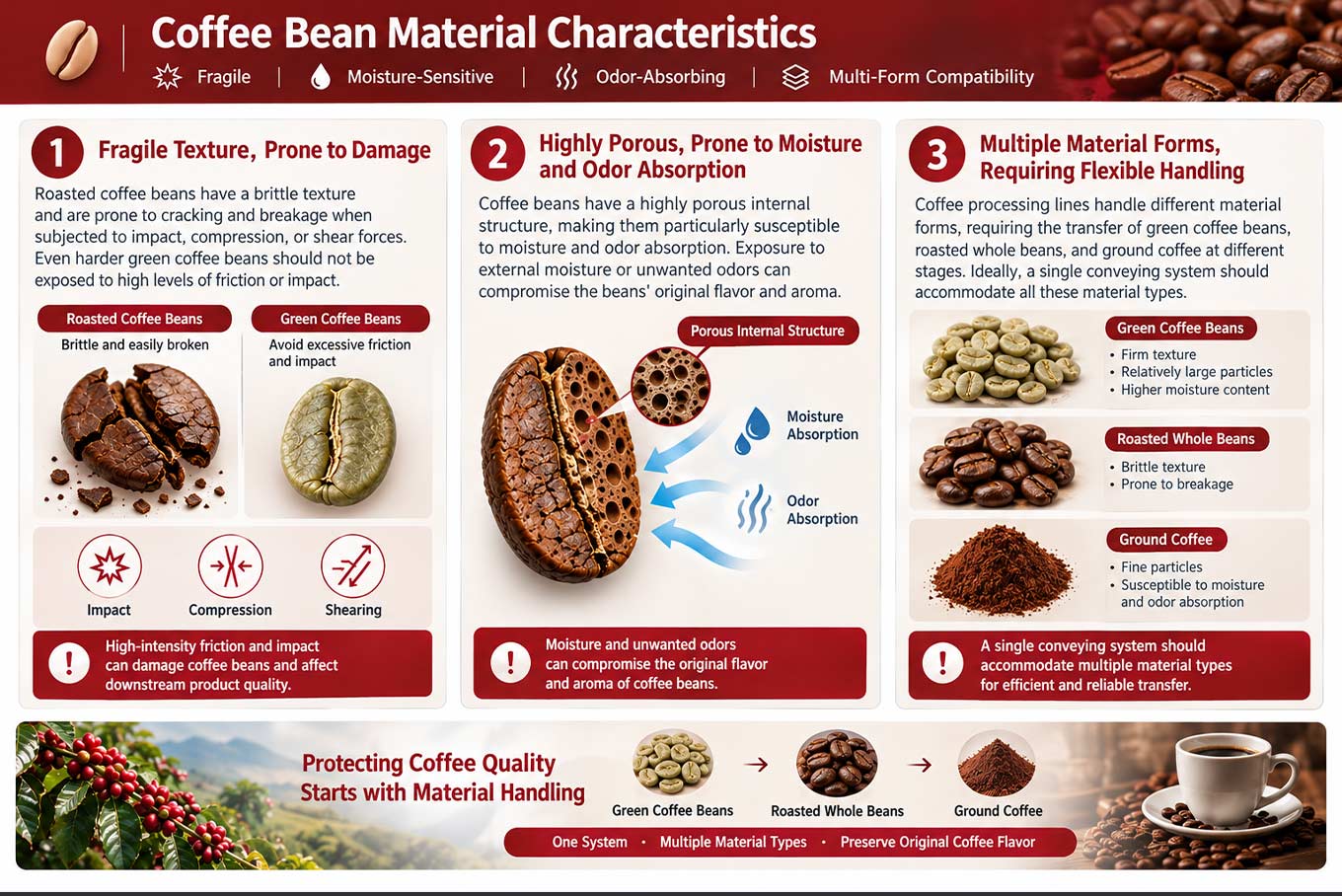
Characteristics of Coffee Bean Materials
After roasting, coffee beans are crispy and prone to cracking and breaking when subjected to impacts, compressions, and shear forces; even harder raw coffee beans are not suitable for high-intensity friction and impact.
Coffee beans have well-developed internal pores, making them very susceptible to absorbing moisture and absorbing odors. Once exposed to external moisture and odors, the original coffee flavor will be damaged.
The material forms on the production line are diverse, including raw coffee beans, roasted whole beans, and ground coffee powder. These materials need to be alternately transported. A single piece of equipment should preferably be compatible with multiple materials.
Common Problems with Traditional Transportation Equipment
- ►Screw Conveyor:Propels materials through screw blades. The blades will shear and compress coffee beans, resulting in a high rate of breakage; the oil in the materials is prone to adhere to the blades, causing cross-contamination between batches.
- ►Bucket Elevator:The feeding and discharging processes involve free falling and impact of materials, causing repeated collisions and cracking of coffee beans, making it difficult to control the breakage rate.
- ►Belt Conveyor: It is an open-type conveyor, and coffee beans are prone to absorbing moisture and dust. The surface of the belt is highly prone to adhering coffee oil, making cleaning and maintenance very difficult.
- ►Pneumatic Conveyor:Propels materials through high-speed air flow. The beans will collide violently with each other, resulting in high material breakage and loss.
To stabilize the breakage rate at less than 1%, it is not enough to only focus on the sealing performance of the equipment. The movement mode of the materials is the core key, and this is also the core technical advantage of EXCT Tubular Drag Conveyors.
Principles of Tubular Drag Chain Conveyors Achieving a Coffee Bean Breakage Rate of Less Than 1%
Working Principle
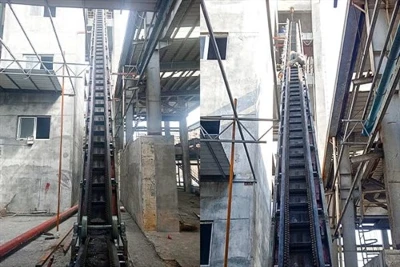
Tubular drag chain conveyors are closed-pipe continuous conveying equipment that uses a closed-loop chain to drive the discs to rotate in the pipe.
During horizontal transportation, the coffee beans are pushed by the chain discs. When the internal friction force of the material layer is greater than the friction force between the material and the pipe wall, the coffee beans move forward along with the chain discs, forming a stable piston material flow.
During vertical transportation, the coffee beans at the lower part block the downward movement of the upper part of the material, creating lateral side pressure, which increases the internal friction force of the material to overcome its own weight. The coffee beans then follow the disc plates to complete the transportation.
The entire conveying process is completed within the closed pipe, and there will be no material spillage.
Technical Logic for Achieving Low Breakage Rate
- Slow Overall Material Flow Pushing
The coffee beans are not pushed up or dropped but are slowly pushed forward by the scraper disc. The relative displacement between the beans is very small. By reasonably controlling the running linear speed, the chance of impact and compression at the source is reduced.
- Non-Shear Structure
Unlike the shear structure of spiral blades, a reasonable gap is reserved between the scraper and the pipe wall, which does not have a forced shear effect on the coffee beans, reducing the risk of bean crushing.
- Piston-Type Material Flow Buffering, Mitigating Single Point Impact Force
A continuous and stable piston material layer is formed inside the pipe, allowing the beans to buffer against each other. The external force on a single bean is dispersed and dissipated by the entire material layer, reducing the local stress damage to the coffee bean.
Pre-conditions for a Breakage Rate of Less Than 1%
Not any tubular drag chain conveyor can achieve a breakage rate of less than 1%.
Ordinary industrial-purpose tubular drag chain conveyors are designed for mineral ores and chemical powder materials. If you directly use them to transport coffee beans, it is difficult to meet the breakage indicators.
To stably achieve a breakage rate of less than 1%, the pipe diameter, scraper gap, chain running speed, feed diversion structure, and scraper material all need to be specially optimized and customized for coffee bean conditions.
Why Tubular Drag Chain Conveyors Are Suitable for Transporting Coffee Beans?
Full Closed-Pipe Transportation
The material is transported throughout the closed pipe, completely isolated from the outside air.
It can prevent the invasion of moisture from the workshop environment into the pipe and protect the original flavor of roasted coffee beans; at the same time, it eliminates the spillage of dust outside, and does not require additional dust removal equipment, allowing the workshop to remain clean.
No odors or impurities from the outside can enter the pipe interior, reducing the risk of coffee beans being contaminated at the hardware level.
Food-grade Material Solution
EXCT coffee bean-specific Tubular Chain Conveyors can use SUS304 or SUS316L polished stainless steel round pipes for the material contact parts.
- SUS304: Suitable for most coffee bean processing conditions, with a smooth inner wall, and coffee oil and fine bean debris are less likely to adhere and remain.
- SUS316L: Suitable for production environments with high humidity and frequent water washing and cleaning, with stronger corrosion resistance.
Combined with food-grade wear-resistant scrapers, the material meets food contact-related specifications, does not release harmful substances, reduces coffee oil adhesion, and lowers the risk of cross-contamination between different batches of materials.
Compatibility with Multiple Forms of Coffee Materials
The same customized pipe chain equipment can be used to transport raw coffee beans, roasted whole beans, and coffee ground powder.
It can cover the entire process of the coffee roasting workshop: raw bean loading, feed into the roasting machine, cooling and transfer of roasted beans, all the way to the feeding for packaging, suitable for the entire production line flow of your factory.
Three-dimensional Flexible Layout
Tubular drag chain conveyors support three-dimensional combinations of horizontal, vertical, inclined, and bent transportation.
The horizontal transportation can reach up to 80 meters, the vertical lifting can reach up to 40 meters, and it also supports multi-point feeding and multi-point discharging.
Facing the renovation of old factories, you don't need to carry out large-scale demolition and renovation of buildings. The equipment can ingeniously bypass the factory beams and columns and the original machinery and equipment, suitable for the complex process layout of large, medium, and small-sized roasting factories.
Low Energy Consumption and Low Noise
The entire machine is equipped with only one drive motor, and the overall power consumption is low.
The materials are smoothly pushed in the pipeline, and the equipment operation noise is low.
With a modular structure, you can quickly open the access panel to clean the residual coffee oil and bean debris inside the pipeline. The daily maintenance workload is relatively small.
Comparison of Various Coffee Bean Transport Equipment
|
Comparison Criteria |
Food-grade Tubular |
Screw Conveyor |
Bucket Elevator |
Belt Conveyor |
Pneumatic Conveyor |
|
Coffee Bean |
Can be < 1% |
2–4% |
2–5% |
1.5–3% |
3–8% |
|
Sealing, |
Fully sealed, |
Semi-sealed, |
Semi-sealed, |
Open type, |
Sealed |
|
Cross-contamination |
Low, easy to |
High, blades prone |
Medium, hopper residue |
High, belt retains |
Medium |
|
Layout Flexibility |
3D routing, |
Primarily |
Suitable for vertical |
Limited to shallow |
Piping can be |
|
Additional Dust |
No additional dust |
Requires dust |
Requires dust |
Dust collection system |
Built-in dust |
|
Compatible |
Green beans, |
Granules, |
Granules, |
Primarily |
Granules + |
Application Scenarios of Tubular Drag Chain Conveyors
- In high-quality coffee roasting factories, strict control is required for the integrity of coffee beans, and the loss of raw materials due to crushed beans needs to be strictly managed.
- The complete material transfer process from raw bean storage to roasting machine, cooling machine, packaging machine needs to be connected seamlessly.
- The workshop has high humidity, and it is necessary to avoid coffee beans absorbing moisture and transferring odors.
- In the renovation of old roasting plants, the on-site space is limited, and it is necessary to bypass the existing equipment and achieve multi-point feeding and discharging.
- One set of equipment needs to alternately transport raw beans, roasted beans, and coffee powder to avoid cross-contamination between batches.
For high production volume and long-distance transportation scenarios, it is necessary to conduct performance calculations in advance to confirm whether the pipe diameter and operating speed match the production requirements.
Achieving a coffee bean crushing rate of less than 1% is not just a marketing gimmick of a single equipment. It is the result of the joint efforts of equipment principles, structural parameters, material selection, and on-site operation and maintenance.
EXCT Tube Chain Conveyors rely on the unique principle of a piston-type low-speed push material flow inside the sealed pipeline to reduce the impact, drop, shearing, and squeezing of coffee beans at their source. Combined with food-grade stainless steel material and three-dimensional flexible layout capabilities, it can simultaneously solve multiple pain points in coffee factories such as crushing loss, moisture absorption and transfer odors, dust pollution, and material cross-contamination.
However, you must remember that ordinary industrial tubular drag chain conveyors cannot be directly used to transport coffee beans. To achieve a crushing rate of less than 1%, it is necessary to require the manufacturer to conduct special parameter optimization and customization for coffee bean materials, and not to directly copy the equipment configuration of powder materials.
If you are the person in charge of a coffee roasting factory or a process engineer, and you hope to control the crushed bean loss in the coffee bean transportation process.
You can provide us with hourly production volume, transportation distance, workshop humidity, and material types. We will conduct a performance assessment for you. Please contact us. EXCT can provide customized solutions for coffee bean tubular drag chain conveyors, output equipment parameters and process layout suggestions, and give you reference for food-grade material selection, helping you achieve a crushing rate of less than 1%.