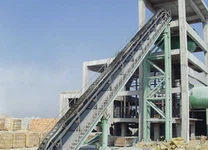
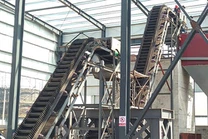
At present, belt conveyors have been widely used in various sectors of the national economy, and in recent years they have become an important part of the combined transport system in opencast and underground mines. There are mainly: steel rope core belt conveyors, steel rope traction tape conveyors and continuous conveying equipment for disposal sites. This paper analyses the characteristics and applications of drive and brake devices for sidewall belt conveyor.

For the inclined conveying material belt conveyor, its average inclination angle is greater than 4 °, when the full load stop will occur when the upper transport material with the reversal and the lower transport material with the smooth phenomenon, thus causing the accumulation of material, flying car and other accidents, so should be set up brake device. Brake is used to slow down the machine or mechanism to stop the device, sometimes can also be used to regulate or limit the running speed of the mechanism, it is to ensure that the mechanism or machine safety and normal work of the important parts.
1. Choice of drive device unit
The load of a belt conveyor is a typical constant torque load and inevitably has to be started and braked with a load (i.e. full start and stop). On the one hand, in order to ensure the necessary starting torque, the motor starting current should be 6~7 times larger than the rated running current, to ensure that the motor does not burn out due to the current impact overheating, and the grid does not lower the voltage excessively due to the high current, which requires the motor to start as fast as possible, i.e. to increase the acceleration of the rotor, so that the starting process does not exceed 3~3 times. In order to do this, in the past, the method of increasing the motor power was used, which is still possible for small and short belt conveyors. On the other hand, the conveyor belt is a viscous body and the traction force (braking force) applied to the belt by the drive unit during the unstable phase of starting (braking).
The inertia force will be propagated, superimposed and reflected in the belt at a certain wave speed, causing multilateral stress changes in the belt.
This requires the smallest possible starting (braking) acceleration to reduce the impact when starting (braking). The starting acceleration of modern belt conveyors is required to be controlled between 0.1-0.3m/s.
Sidewall belt conveyor are subjected to stress changes in the conveyor belt when braking. The stress changes that occur on the belt are sometimes even more drastic than when starting. In order to solve this contradiction and to ease the impact on the motor, fluid couplings, controlled reducers and CST controlled drive systems are often used. The drive unit is the source of power for the entire belt conveyor and consists of an electric motor, reducer, coupling, backstop and drive pulley. The drive roller is powered by one or two motors that transmit torque to the drive roller via their respective couplings, reducers and chain couplings. The drive roller is of welded construction and the main bearing is of spherical bearing. The frame of the drive roller and the frame of the motor and reducer are mounted on a large fixed base, and the motor can be mounted on either side of the head of sidewall belt conveyor.