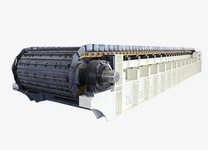
The Tubular Drag Chain Conveyors (also known as Tubular Drag Conveyors or Disc Chain Conveyor) is a continuous conveying equipment specifically designed for transporting powdery, small granular, and small block-shaped bulk materials.
Its essence is a conveying system that "uses a sealed pipeline as the channel and chain plates or circular Disc as the transmission carrier". It can achieve horizontal, inclined, vertical, and three-dimensional combined conveying, and can complete the material transfer along complex routes without the need for multiple equipment for transfer.
Compared with traditional conveying equipment, its core differences lie in three aspects: First, the fully enclosed design completely eliminates dust pollution; second, the flexible layout in three-dimensional space is suitable for complex factory structures; third, the low wear conveying method protects the particle shape of the materials to the greatest extent, which is also the key reason why it is indispensable in special working conditions.
Tubular Drag Chain Conveyors Working Principle
● This equipment uses a sealed pipeline as the conveying channel. It is driven by a driving device to make the built-in chain disc rotate at a constant speed. Through the chain disc, the materials are pushed along the pipeline to achieve continuous conveying.
● During horizontal conveying, the chain disc exerts a forward thrust, utilizing the principle that the internal friction force between the material layers is greater than the external friction force of the pipe wall, to form a stable material flow and prevent material accumulation and sliding.
● During vertical conveying, continuous feeding from the lower part creates a lateral pressure on the materials, increasing the internal friction force of the materials, overcoming the friction of the pipe wall and the self-weight, and completing the vertical lift smoothly.
● Our equipment adopts an optimized design of sprockets and wear-resistant conveying discs. It operates at a low speed and is more stable. It can not only reduce material friction loss and lower the damage rate, but also effectively extend the overall service life of the equipment.
Tubular Drag Chain Conveyors Structure
A high-quality Tube Chain Conveyors must have a structure design that takes into account stability, flexibility and adaptability. It is mainly composed of five core components:
Core Functional Components
- Drive Unit: Provides stable power for the operation of the chain and chain disc, serving as the "heart" of the equipment. The power is flexibly configured according to the conveying volume and distance.
- Tensioning Device: This is used to adjust the tension of the chain, ensuring that the chain disc makes a tight contact with the materials and preventing the chain from loosening, which would affect the conveying efficiency.
- Steering Device: A key component suitable for three-dimensional layouts, capable of achieving steering in any direction such as horizontal, vertical, and inclined, meeting the requirements of complex routes;
- Sealed Pipeline: The core channel for material transportation, fully enclosed to prevent dust from escaping and protect the materials from external contamination;
- Chain&Disc: A transmission component that comes into direct contact with the material. It is made of wear-resistant material to ensure sufficient pushing force and prevent rapid wear.

Material Compatibility Characteristics
The pipe material offers a wide range of options, including food-grade stainless steel, carbon steel, nylon, etc. It can be customized according to industry requirements: for the food industry, food-grade stainless steel is selected to meet hygiene standards; for the chemical industry, stainless steel is chosen to handle corrosive materials; for general working conditions, carbon steel can be selected, balancing cost and practicality.
Layout And Measurement Design
- Layout Design: The conveying pipelines can be flexibly combined and support various forms such as horizontal, vertical, inclined, curved, and looping, which can adapt to narrow and complex factory structures, with extremely high space utilization rate;
- Measurement Design: Based on the volumetric conveying principle, the flow is stable and easy to control. The distance between the inlet can exceed 10 meters, meeting the measurement requirements for different feeding scenarios.
Tubular Drag Chain Conveyors Advantages
The design of Tubular Drag Chain Conveyors endows it with a series of irreplaceable advantages, making it the preferred equipment for special working conditions:
Fully Enclosed Dust-Free Conveying
During the entire conveying process, the materials are completely within the sealed pipeline, completely eliminating the escape of dust. This not only complies with environmental protection policies but also ensures the occupational health of operators. It is particularly suitable for industries sensitive to dust pollution (such as chemicals, food, and new energy).
Flexible Three-Dimensional Layout
This is one of the most significant advantages of the Chain And Disc Conveyors. The conveying pipeline can turn and reroute at will according to the structure of the factory building. Without the need for large-scale site renovation, it can achieve material conveying along complex routes, perfectly adapting to narrow and multi-level production environments.
Multi-Functional Integrated Conveying
One device can simultaneously complete combined conveying in various directions (horizontal, vertical, and inclined). There is no need to connect multiple devices for transfer, simplifying the process flow, reducing equipment investment and floor space, and lowering production and operation costs.
Wide Material Adaptability
From dry flour, plastic particles, to viscous sludge, filter cakes, to wear-resistant mineral powder, cement, and even easily tangled materials, the Tubular Drag Chain Conveyors can effectively handle them. It is suitable for various forms and characteristics of loose materials, with an extremely wide range of applications.
Low Wear And Low Damage
The equipment operates at a slow speed, with static or low-speed friction between the materials and the pipeline and chain discs. This not only provides excellent protection for the material particle morphology (especially suitable for fragile and perishable materials) but also causes less wear to the equipment itself, prolonging the equipment's service life and reducing maintenance costs.
Stable Conveying Capacity
Based on the volumetric conveying principle, the equipment's conveying flow is stable, easy to measure and control, and can precisely match the material requirements of the production process, ensuring the continuity and stability of the production process.
Tubular Drag Chain Conveyors Applications
With its strong adaptability and advantages, Chain And Disc Conveyors have been widely applied in various industries, becoming a "all-rounder" for the transportation of bulk materials:
► Chemical Industry
Suitable for the transportation of materials such as pigments, dyes, coatings, carbon black, resins, titanium dioxide, iron oxide, ceramic powder, heavy calcium, light calcium, bentonite, molecular sieves, kaolin, silica gel powder, activated carbon, etc., solving the problems of dust pollution and the transportation of corrosive materials.
► Pesticide And Mineral Industry
Can transport urea, ammonium chloride, ammonium bicarbonate, soda powder, solid pesticides, tungsten powder, pesticide additives, copper concentrate powder, coal powder, phosphorus ore powder, aluminum oxide powder, wood chip powder, glass fiber, silicon dioxide, talc powder, etc., adapting to the complex layouts and large-scale transportation needs of mines and pesticide factories.
► Building Materials Industry
Applicable to materials such as cement, fly ash, clay, bentonite, sand, quartz sand, clay powder, silica stone, limestone powder, dolomite powder, wood chip powder, glass fiber, silicon dioxide, talc powder, etc., capable of flexible layout in narrow building material factories.
► Plastic Industry
Suitable for transporting PE, PP, PVC plastic particles and powders, with a low damage rate that can protect the shape of plastic particles and ensure product quality.
► Food Industry
Suitable for materials such as malt, grains, coffee, dried fruits, sesame, peanuts, flour, starch, sugar, milk powder, food additives, etc., with food-grade stainless steel material meeting hygiene standards, and fully sealed design to prevent material contamination.
► New Energy Industry
For sensitive materials such as lithium battery positive and negative electrode materials, graphite, etc., fully sealed transportation can avoid dust leakage and material moisture, low wear characteristics protect material performance, and adapt to the high standards requirements of the new energy industry.
► Environmental Protection Industry
Can effectively transport environmental protection materials such as sludge, dried biomass pellets, etc., solving the problems of difficult transportation of viscous materials and secondary pollution.
How To Select The Type Of Tubular Drag Chain Conveyors?
When selecting the type, there is no need to blindly pursue high parameters. The key lies in "precise matching". The following four steps can be followed:
Determine The Material Properties
First, determine the type of material (powder / granular / small block), particle size, humidity, viscosity, corrosiveness, and whether it is prone to damage. Based on this, select the pipe and chain plate materials (for example, choose corrosion-resistant materials for corrosive materials, and low-maintenance design for fragile materials).
Lock In The Scene Requirements
Confirm the conveying direction (horizontal / vertical / combination), the layout of the factory building (whether it is narrow, whether it needs to be detoured, floor height), and the installation location (such as warehouse in a building, corner of a workshop). Determine the layout form and size parameters of the equipment.
Calculate The Production Capacity Requirements
Based on the hourly conveying volume and the demand for production continuity, match the conveying capacity and power parameters of the equipment to ensure that the equipment can meet the production capacity requirements, while avoiding overcapacity and resulting waste.
Consider Industry Standards
Different industries have different compliance requirements: the food industry needs to meet hygiene standards, the chemical industry needs to meet corrosion and explosion-proof requirements, the new energy industry needs to ensure the purity of the materials. When selecting, it is necessary to clearly define the industry standards in advance to ensure the compliance of the equipment.
The reason why Tubular Drag Chain Conveyors have become a favorite among many industries lies in their ability to precisely address the pain points that traditional conveying equipment cannot handle. Whether it is a chemical workshop with strict environmental requirements, a complex building warehouse, or a food factory with extremely high standards for material quality, it can become a "good helper" for improving efficiency by virtue of its fully enclosed, flexible layout, and low loss characteristics.
If you are facing problems with the transportation of bulk materials, such as difficult dust pollution control, restrictions on the layout of the factory building affecting the conveying route, and high material damage rates affecting quality, please feel free to talk to us. We can provide customized Tubular Drag Chain Conveyors solutions based on your material characteristics, site conditions, and production capacity requirements. From parameter matching to layout design, we will be with you throughout the process to ensure that the equipment truly meets your production needs and achieves a win-win situation of environmental protection and efficiency. We look forward to working with you to make material transportation smoother and more efficient!