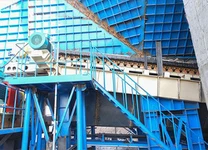
In industrial production, the transportation of bulk materials such as ores, coal, and sandstone is ubiquitous. However, through years of industry service experience, we have discovered that the shortcomings of traditional conveying equipment often become the bottleneck of your production efficiency.
Belt conveyors, as the basic equipment, can only be adapted for horizontal or gentle slope transportation; bucket elevators, although capable of vertical lifting, have a single path and are difficult to maintain. Both of them are unable to balance efficiency and cost in scenarios such as large inclinations, complex spaces, and multi-material compatibility.
Our sidewall belt conveyor(corrugated sidewall belt conveyor)is a continuous conveying equipment specially designed for the large-angle, vertical and spatially curved transportation of bulk materials.
Its core structure consists of "base belt + sidewall + cleat", and the three components work together to form a closed or semi-closed material hopper carrying unit, which can effectively prevent the scattered materials from sliding during the climbing process. This is the core design feature of our equipment.
This equipment covers an inclination angle of 30° - 90° (capable of vertical transportation), and can also support "Z" shape and "S" shape spatially curved transportation. Through customized design, it can meet your special requirements such as high temperature, anti-corrosion, and sealing.

Belt Conveyor

The belt conveyor, which relies on a flat conveyor belt to achieve continuous horizontal or gentle slope transportation of bulk materials, is the most widely used basic conveying equipment in the industrial field.
Its structure is simple and the initial investment is low, but the maximum inclination angle does not exceed 30°, and it can only achieve linear or gentle slope transportation.
Due to the lack of anti-slip structures, when transporting at the maximum inclination angle, there is a tendency for materials to slide, and its adaptability to complex spaces and scenarios with large inclination angles is extremely poor.
The bucket elevator uses chain transmission to drive the hopper to scoop up materials. Its core function is to achieve vertical or small-angle lifting of bulk materials.
It is suitable for short-distance, small-batch, and fixed-path vertical transportation scenarios. Although it can achieve 90° vertical transportation, the transportation path is limited and the flexibility is insufficient.
This equipment relies on chain transmission. The chain and the hopper wear out quickly and require frequent maintenance. Moreover, the conveying capacity and material compatibility have a significant upper limit, and it cannot meet the transportation needs of large-scale and complex scenarios.

Advantage Comparison: Sidewall Belt Conveyor VS Belt Conveyor&Bucket Elevator
Angle Adaptability
Our sidewall belt conveyor has an angle range of 30° - 90°, enabling vertical transportation. This breaks through the bottleneck of belt conveyor where the angle is ≤ 30°, and the material is prone to sliding. Although it has an angle comparable to that of the bucket elevator (90° vertical), our sidewall belt conveyor supports curved space transportation, and its flexibility far exceeds that of the bucket elevator, which can adapt to complex layouts.
Space Utilization
Our sidewall belt conveyor does not require extensive line laying. It can achieve large height lifting in a narrow space, saving site costs. However, a belt conveyor needs to reserve long straight/steep slope spaces, which makes the layout difficult and the space utilization low. A bucket elevator needs to be fixed and installed vertically, making it unable to be flexibly adjusted and having extremely poor adaptability.
Discharge Capacity
Our sidewall belt conveyor has a single-unit discharge capacity of ≥ 800 t/h, which can replace multiple series-connected bucket elevators; for belt conveyor with large height lift, multiple units need to be linked together, resulting in a complex process; the single-unit discharge capacity of bucket elevator is small, and the stability of multiple-linked units is poor, which affects your continuous production.
Material Leakage Prevention and Environmental Protection
Our Sidewall Belt Conveyor achieves leakage prevention and dust-free operation through guard edges and cross partitions, meeting environmental protection requirements. However, Belt Conveyors do not have leakage prevention structures, and materials with a large inclination angle are prone to sliding and falling, resulting in waste and environmental pollution. Bucket Elevators generate a lot of dust during unloading, and sticky materials are prone to sticking together, increasing your environmental protection and cleaning costs.
Energy Consumption
The frictional resistance of our sidewall belt conveyor is only one-third that of the bucket type. In scenarios with a large inclination angle, it can save up to 30% of energy compared to the belt conveyor, significantly reducing your electricity expenses. The bucket elevator has the highest energy consumption and faces significant operational pressure over the long term. For belt conveyors, when achieving a large height lift, multiple units need to be connected in series, resulting in relatively high total energy consumption.
Maintenance Costs
Our sidewall belt conveyor has no easily worn parts, has a low failure rate, and is simple to maintain on a daily basis, significantly reducing your operation and maintenance costs; the belt conveyor requires frequent cleaning of spilled materials and is prone to deviation, resulting in a large amount of maintenance work; the chains and bins of the bucket elevator wear out quickly and need to be replaced regularly, which affects the continuity of production.
Equipment Lifespan
Our sidewall belt conveyor is made of high-strength and wear-resistant materials, suitable for harsh working conditions. Its lifespan is much longer than that of traditional equipment, reducing your replacement costs. Belt conveyors are prone to wear and have a short lifespan; bucket elevators have chains and hoppers that are easily damaged, and their lifespan is even shorter in high-temperature and sticky material scenarios.
Noise Control Advantages
Our sidewall belt conveyor operates with a noise level of ≤ 75 dB, which complies with environmental protection standards and improves the working environment for operators. In scenarios with a large belt conveyor inclination angle, noise levels are high and may require rectification. The noise level of bucket elevators exceeds the standard and additional noise reduction costs will be required.
Material Compatibility
Our sidewall belt conveyor can accommodate blocks, granules, and powdered bulk materials, and supports customized requirements such as high temperature (150℃) and corrosion resistance; the belt conveyor has poor adaptability to large particles, viscous materials, and high-temperature materials; bucket elevators are prone to clogging and sticking, and are damaged by large particles, and have a narrow range of applications.
Installation Difficulty And Flexibility
Our sidewall belt conveyor supports modular and foldable installation, which is quick to debug and easy to adjust in the future, suitable for your capacity expansion and layout optimization. The path of the belt conveyor can be modified after installation; the bucket elevator needs to be fixed and installed vertically, with no flexibility at all.
Adaptability to non-standard Scenarios
Our sidewall belt conveyor can cover non-standard scenarios such as mines, tunnels, hazardous waste, and low temperatures (-60℃), and supports variable inclinations (-10° to +50°) and complex path transportation. Belt conveyors and bucket elevators can only be adapted to standardized scenarios and cannot meet your requirements for complex working conditions.
Compared with Belt Conveyors and Bucket Elevators, our Sidewall Belt Conveyor has significant and irreplaceable advantages in core dimensions such as high-angle transportation, adaptability to complex spaces, low energy consumption, low maintenance costs, and multi-material compatibility.
It is the preferred solution for modern industrial bulk material transportation, especially suitable for you who have the requirements of high-angle, complex paths, and multi-scenario compatibility for transportation.
If you have confusion in selecting bulk material transportation equipment, or want to customize an exclusive solution for scenarios such as high-angle, complex paths, and multi-material compatibility, please feel free to contact us at any time. We will combine our years of industry experience with your actual working conditions to provide professional equipment selection guidance, technical parameter explanations, and full-scale operation support, helping your production line improve quality, reduce costs, operate in compliance and efficiently.